Showing posts with label bikes. Show all posts

Thursday, September 10, 2009

Goodbye IRO

My faithful everyday bike, which hasn't really seen a whole lot of use in the past year, is going to a new home.

I got this bike in 2005. Prior to that, I had a junky fixed gear conversion, and wanted something a bit more held-together. It was the first time I had bought myself something nice - other than my guitar amp. I used it to go on my first "long ride," from NYC's Chinatown to my parents' house in Bergen County, NJ. Almost twenty miles, stopping every now and then on the West Side Bike Path to tug the toestraps tighter. That ride made me decide that I wanted to be a little bit healthier, to get better at riding this bike.

Then I took it with me to live in Bridgeport, Connecticut, where it was a valuable companion in that lonely city. I used it to explore the seaside, the factories, the quiet and ramshackle neighborhoods. When my time there was up, I took it to the Bronx and discovered the fun and odd world of urban cycling. I got hit by a livery cab making a capricious u-turn underneath the elevated 2/5 on Westchester Avenue, which led me to get chewed out by a rookie cop posing tough for his partner, and hugged by the tearful, fearful, and carelss driver who was so relieved I was okay (and I was relieved that the bike was fine). I rode the Tour de Bronx and hoped that I'd be introduced to the person riding the yellow KHS. I rode Critical Mass and met the rider of the KHS. She doesn't have the KHS anymore, but a few other really nice bikes are filling up our bike room.
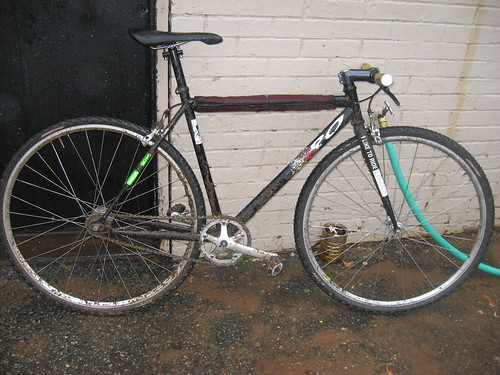
Soon I was swinging my leg over its handlebars for alleycat races. Some respectable finishes made me catch a racing bug that led me to get a track bike, a road bike, and a cyclocross bike - after racing the IRO on the Kissena Velodrome, taking it up and down 9W, and throwing some knobbies on it and racing it at StatenCX. Anywhere I went it took me there first.

It's gone through saddle swaps, a myriad handlebar configurations, and more wheel swaps than I can count. I think I even had matching wheels on it for a month or two. Once, in a pinch, I attached a threadless stem to its seatpost, put some bullhorns in it, and taped a bunch of cargo to this impromptu rack. I slowly and haphazardly added stickers. Spending two winters working food delivery shifts helped transform it from the pretty (if simple) thing I adored to a rugged tool that got thrown against poles, covered in snow, and rattled senseless over cobblestones. Other bikes got babied - the Pogliaghi, the Felt, the Co-Motion. And then, they too went through a similar transformation. At Fawn Grove I winced as gravel bounced all over the race course, flying off tires, not because they were slamming into my shins (though they were), but because they were slamming into my road bike's downtube. And halfway, as my body was well in the red, my head changed, and the bike had become what the IRO had become - a tool.

But with a new bike on the way, built for more specific uses, the IRO has got to go. A bike stable should keep sentimentality to a minimum, I think, and even when living space isn't at the same premium at which it used to be, the inclination toward maximum-bike ought to be curbed.

It's not the bike - it's the memories.

Thursday, August 6, 2009

Squarebuilt

Squarebuilt bicycles are among the nicest handmade bikes coming out of New York City (with a nod to Johnny Coast, who's been doing it a bit longer). I've had my hands a few of the frames made in this little shop, and they sure are lovely.

Apparently, a few of them are more than a little bit cursed. Messenger bikes are footsoldiers in a very odd war, and Joey Krillz's bike (before and after) is the latest fatality. Fortunately he's fine - the bike was smashed by a truck while locked up, which is kind of like surviving the sinking of the Titanic only to die of pneumonia on the Carpathia. Regretably, it's not the first. Krillz's colleague Drew has had some ill tides wash over his Squarebuilt (before and after), and said, "Squarebuilt bicycles are the kamikaze pilots of the custom frame world. They burn bright, make their masters proud and die young in horrifying, senseless collisions."

Friday, May 15, 2009

Figuring it out

Riding without a computer at the Bear Mountain Classic may have given me the confidence to bomb that descent a bit more aggressively than I would otherwise. Unlike at Battenkill, I know that I wasn't eyeing the speedometer every few seconds, watching it climb higher and higher. We were over 50mph - of this I'm confident - but I had few of the wide-eyed high-speed what-if jitters that I sometimes get when I know how fast I'm going. Ignorance is bliss.

It's important to ride, to just ride. Not for work, or to get to work, or to race and feel good about winning or bad about losing, so I'm starting to get very excited about tomorrow morning. I need some fast/casual fun/hard no-demands hours in the saddle. Housatonic Hills is coming up, and I can't let track racing, with its fast scratch races and endless sprints, make me forget how to ride for longer than a few minutes or slower than 27mph (when necessary).

I have no interest in hitting a mid-season physical or emotional wall, which means that here on out it's going to be important to monitor how I'm riding and racing so that I can keep feeling good and avoid burn-out. And that means opening up time for fun rides over the river and through the woods, for the dual purpose of fulfilling the sacred duty of going somewhere aimlessly, and getting strong(er, still), so that I don't get caught out in the sprint (that's my face peering out from behind the rider in red).

Friday, May 1, 2009

Some Handlebars Are More Equal Than Others

Friday morning, I woke up early to change handlebars on my road bike before I left for work - again. Last week I had put on a different set of handlebars, looking to get a deeper, lower position than my preferred handlebars, Ritchey Biomax bars, afforded me.

I first realized the importance of handlebars and bike fit a little over a year ago, when, after many rides fidgeting and trying to get comfortable on some deep, square-ish ergo drop bars, I picked up those Ritchey bars because of their shallower drop, slight flare, and what I thought would be a more comfortable angle of the ergo section. I realized that the reach was shorter and that given the incredibly wide variety of handlebars, choosing the right handlebar was as much a matter of proper fit on the bicycle as was installing the right length stem. When I discussed bicycle fit with people - especially people for whom bike fit is somewhat tricky, like short people (like myself) - I would always bring up handlebar choice.

This became additionally important when I saw how many entry-level track racers fit themselves on track bikes. I saw a lot of people riding very close and deep; their arms went almost straight down to very deep drop bars. When I bought my Felt, one of the first things I did was give away the ultra-deep Deda drop bars and get Nitto B125s, shallow-drop track bars that are comparable to criterium bars; I recently put on a 120mm stem. My drop isn't extreme and I'm reaching out to the bars a bit more than I'm reaching down to them - it's a stable, long fit that I feel gives me good weight distribution, a good diaphragm-opening reach, and an aero enough posture, without compromising the bike's handling.

Considering my discovery of the importance of handlebar ft, I was pleased to come across this site, which has animations of the different geometries of different drop bars, illustrating the significant differences in reach and drop that different types of handlebars afford. With longer-reach bars having perhaps as much as 3 centimeters more reach than others (which was the case with the bars I just removed from my bike), it's important not to neglect this aspect of bike fit - as much as it's important to not arbitrarily use an 80mm stem rather than a 110mm.

It doesn't necessarily take an experienced and expensive fitter to get yourself comfortable on the bike, although the cost/benefit of that might work out in your favor if you're looking to align optimal comfort with optimal performance, with some other difficult variables thrown in. An amateur can play around by looking at other people's fit, experimenting with saddle position, stem length, and, of course, handlebar dimension.

Sunday, March 1, 2009

Relaxing, Bike Handling, and 09's First Race

For a few more road races, I'll be racing in the Cat 5's. I talk a big game, like I know what I'm talking about, but that's mostly because I'm a nerd rather than somebody who's done a lot of racing. Writing this blog is a way to articulate my own learning process.

One of the things I've been learning over and over again this winter is that a relaxed upper body goes a long way toward improving one's cycling. I realized, several weeks ago when I was out on the first long ride in nice weather of the late winter, that my torso and arms were a lot more relaxed while riding. I attribute it to spending time riding on rollers this winter. They force you to relax and let the bike do it's thing. If you try to manhandle it, you'll overcompensate in a snap and ride yourself right off the front roller, into the doorframe, chair, or whatever you are using for support.

Bikes are really great at handling themselves. The way the steering works is really remarkable, taking the fork rake, head tube angle, and lean of the bike into account in a fine equilibrium that really does most of the work for you. I learned, by riding on some terrible urban terrain (loose cobblestones, ruts, and poor asphalt) that the bike can control itself if you take a backseat role. Literally: push your weight back on the saddle, over the rear wheel, and focus on transmitting power to the pedals. Lighten your grip on the bars and let your upper body get loose. The front end will perform its remarkable feat of self-correction.

I put this skill to good use in November's Staten CX race in a section full of off-camber turns, exposed roots, ruts, and rocks. I sat back and powered through, surprising one rider who seemed to gingerly work a line through the mess - as I plowed through he looked up and asked, "How'd you do that?" Poor bike handling in part stems from tension or overcontrol of the bike, and something that I realized in yesterday's Cadence Cup Prospect Park Series (Cat 5 field, remember) is that staying relaxed in a tight pack when there is some oddball behavior around you (riders jamming themselves left to right in their eagerness, and moving unpredictably to capriciously go after a new wheel) - particularly at high speeds - may very well make the difference between staying upright and taking a tumble.

And, though I'm going to largely avoid full-blown race reports, the first race of the season went well. A teammate and I attacked on the second lap, hard, at the top of the "hill." We were away for only about a mile before the pack, still fresh, reeled us in. A lap later, the pace was very high, and then dropped quite suddenly when a lone rider went up the road and nobody was able to respond anymore. I was staying sheltered, twenty wheels back, at that point, still recovering. The rider gained significant time. The pace picked up well on the last half of the last lap, on a fast section of road. There were a few edgy moments at 34mph in a pack tighter than it needed to be, as a lot of people tried to get to the front. But when the terrain stopped providing the speed, the front didn't want to take over and the pace slowed down to maybe 24mph instead of ramping up the speed for a field sprint. So I attacked, hard, with about 800 meters to go. I opened a big gap and went cross-eyed trying to hold my speed and hold off the inevitable field sprint. And I did, mostly. The lead sprinter got me at the line; I threw my bike to prevent the second from doing so, too, and got 3rd place.

Next up: two crits in Connecticut next weekend. I'm taking it easy today, for fun rather than out of a need to recover, and will go for a long hard ride tomorrow.

Saturday, January 3, 2009

Hipster Trickster Idiocy


John Prolly wrote a pretty good piece for Urban Velo magazine about fixed gear freestyling, here. John is one of the more public figures in the FIX/MX (or 700CMX) trend - using full-sized fixed gear bikes for BMX-derived trick riding.

I've been impressed at how how skill throw-downs have evolved in the past few years. When I started racing alleycat races, side events featured track bike skid competitions. There was nothing cooler than a smoothly executed one-leg-over-the-handlebar, 360-degree skid, as a legion of sweaty bike kids clutching brown-bagged beers cheer on. But the a few people started to barspin and do wheelies, and all of a sudden there was another level of grace, coordination, and control on the bike.

And, in a just over two short years, it's booming. Companies are producing barspin-able bikes and beefy components made for slamming around. John himself is adamant that he doesn't ride a track bike - this is a different monster altogether. It's not a bike repossessed for a new purpose, like a track bike ridden on the street is. It's a fixed-gear trick bike - something tough, reliable, and, most importantly, ridable. It's a new kind of bike.

There's a lot of scorn for this field, as there always is for a developing niche. "Just get a BMX bike" kind of contrasts with the track-bike orthodoxy ("death before derailleurs!") that occasionally develops. But one of the things I admire about John is that he embraces the fact that it's not about track bikes. It's about riding and being able to ride to new places, and the fact that he's so willing to experiment with new pieces of gear - some of which are god-awfully ugly according to the conventional aesthetics - says that he's more interested in the function than the form. I mean, come on! Unicrown forks are hideous, 40 spoke wheels are ridiculous, 28mm wide tires are overkill for a 125-pound weakling like myself, who can't bunnyhop something higher than a curb. Riser bars... the list goes on. I hate all those bits and pieces. And yet they make perfect sense for these new bikes, and, well, that's okay. That's just fine. In fact, it's right-on. Exactly where it needs to be, with form following function.

Considering the way that cycling scenes tend to play out, abandoning form-first mentality means abandoning silly orthodoxies, more-authentic-than-thou idiocy, and general interdisciplinary trash-talking. John just likes to go ride his bike and do wacky shit on it. In collaboration with a couple companies and a bunch of other riders they've been identifying parts and designs that can survive this (ab)use. They're not perverting any old stock of riding history, they're creating a new one, and that's a lot of fun to watch. Not just because I've always been interested in the dynamics of temporal emergence (to borrow a term from my University days, but because some of the shit that they do on bikes is really cool.

BikesnobNYC can't stop giving John a hard time, but whatever. I like what John's doing, even if can't help but roll my eyes every time I see pictures posted on bikeforums featuring a super-short stem, riser bars reaching for the sky, and a 650 wheel in a fork meant for 700s... or, in other ways, just using the wrong tool for the job. Some of this stuff makes for nonsense bikes but it doesn't mean that the whole discipline is nonsense.

I mean hey, BMX was an Olympic sport in 2008. Things change.

That's the point.

I know I've got at least a couple readers who aren't quite so familiar with the city fixed gear scene, so, I welcome your reactions. Here is a little bit more data for your research (youtube).

Sunday, November 23, 2008

Staten Island Cross!

If you keep up with Bike Snob NYC - which you shouldn't, as he's ran out of witticisms and his blog posts serve only as a medium for a surprising volume of spectator idiocy - then you'd know that next Sunday, November 30th, New York City will see its first cyclocross race in over ten years.

Those of us who've never raced 'cross know it as a sport where in order to qualify for the post-race beer-drinking, you've got to spend about an hour getting cold, wet, dirty, and exhausted running, pushing, fouling, and occasionally riding a bike that's only marginally suited for the terrain at hand.

And we've also learned that everyone who rides cyclocross absolutely loves it.

The organizers of Nov 30th's Staten Island Cyclocross, however, seem to have missed last spring's Sludgement Day, a 'cross-inspired mudfest on the curiously out-of-the-way playground/construction site Randall's Island.

But, that aside, Staten Island Cross looks like it will be a blast. I'm going to race it on what may prove to be a wholely inappropriate bicycle.

Photos as I put together a semifunctional cyclocross bike and sack up and register to race will be forthcoming.

Monday, November 3, 2008

Wine, cheese, and bearing grease.

Cycling is on the rise. To hear about greying locals talk about the sport twenty, thirty, or forty years ago, it was a blue-collar sport. Al Toefield was a cop who managed Olympic Teams, got the Kissena Velodrome built, and founded the Kissena Cycle Club; David Walker was a cop too, working in community relations, who started one of New York City's biggest and most enduring races, the Harlem Skyscraper Classic Criterium. Pete Senia, it seems, organized most of the races in the 70s and 80s that laid the foundation for the cycling scene. I hear stories of these men driving vans full of young, aspiring racers - just kids - to the races in the pre-dawn hours of the morning. The scene consisted of a lot of dedicated, working-class men, a lot of immigrants. Circling Prospect Park on a Saturday afternoon, there are still groups of older Caribean men, and mustachioed Latino men, riding bikes from the 70s and 80s - Nuovo Record, downtube shifters - wearing faded colors, muted kits from bygone days.

The working-class flair that local bicycle racing had matches the technology from the time - when you're talking about a lugged steel bike with 32-spoked wheels and downtube shifters, there's really not a huge technological gap between entry level and high-end (leaving out, of course, the 1970s era Bike Boom's drive to create cheaper and cheaper frames and components). Sure, there were ways to ramp up the cost of a bike - get the frame custom made, rely on Cinelli and Campagnolo parts - but at the end of the day, the manufacturing process and the final product between basic and bling were going to look a lot alike.

These days, the price-to-quality graph looks a lot more exponential - the higher you climb, the faster the prices increase, and the less you get for these increases. Campagnolo's new Super Record 11 groupset - cranks, cogs, front and rear derailleurs, brake/shifter levers, and brakes - cost upwards of $2,000, while last year's midlevel groupset, Veloce, sells for around $600. One can get a great frameset for well under a thousand dollars - indeed, just several hundred if you're looking for somethins used - but high-end, specialty carbon fiber framesets can readily run to several thousand dollars, even climbing over the $10,000 mark. The higher up on the scale you go, you pay more and more for smaller and smaller improvements in performance, quality, or manufacturing - a rapidly declining value system.

Ironically, the growing popularity of cycling is turning it into a more exclusive sport. Case in point - I was recently at an event featuring one of the world's greatest cyclists. As the event's attendants inconspicuously crowded around and waited for a pin-sized gap in the conversation so that they could speak to (to, not with) a consistent high finisher in the Paris-Roubaix, the conversation somehow turned to high finance, and almost everybody in this circle - barring myself, a journalist, and Big George Hincapie - chimed in. Not just everybody bearing an opinion about the collapse and the bailout - instead, it seemed that everybody present was in the industry. "Oh, so you must know so-and-so at Big Firm, then." These are the consumers in the new cycling industry, an industry of "it goes to eleven," of this year's model, of custom carbon fiber, of powermeters and high-end aero wheels for the casual racer.

Threads on the internet asking when you know your frame is obsolete. Though people know that while the industry churns out "improvements" each year, the bike that you bought two, four, or ten years ago is still just going to rely on the juice that's in your legs - and yet, the industry plows on and people buy the bikes with the newest graphics. Friends, it's an economy of wine, cheese, and bearing grease, but unlike wine and cheese, I fully plan to turn this to our advantage by looking at the resale markets of so-called "obsolete" components.

Tuesday, September 30, 2008

Bicycle Consumption

I have a friend from my more torn-clothes punk-rock past; I fear her reproach. She lives half in my head and half in the real world - which to say it's entirely possible that I'm imagining the things that she would say, engaging in too much speculation. That I'm using her as a way to externalize my conscience.

We discovered bikes together at the university bike coop, taught each other the hammer-and-duct-tape method of bike mechanics, rode mountain bike beaters around and locked up to street signs and dumpstered miscellaneous parts and frames and pieced together our first fixed gears and, above all, reveled in our bike culture of putting to use the cast-offs from a recklessly wasteful society and building a means of affordable, egalitarian, and secretly subversive transportation. Yes, what I'm trying to say was that those first bikes were indeed pipe bombs.

What would she say now? What would she say to my pretty-but-beat-up classic Italian track bike (with Campy 151 cranks and vintage Zeus hubs)? And what would she say about my aluminum-and-carbon frame that I use exclusively for racing at the track?

There is an inherent strain of consumerism underlying much of cycling culture. This came as a surprise to me, as my main exposure to bike culture was noting that every poor kid in that faded industrial city in New England where I lived after college had a beat-up BMX bike that they'd ride around town, popping and holding huge wheelies. But in New York City, I had easy access to just-out-of-college kids spending whatever didn't go to their student loans on a new frame here, a new wheelset there. NJS this, Italian that. And meanwhile we've got the cyclists who live proximal to Central Park and trot out their Colnagos, Cervelos, and Litespeeds (oh my!) on the weekends, meandering the loop at 18 mph only semi-aerodynamically tucked onto their HED aerobars, looking for all the world like that kid you knew in high school who decided he wanted to learn guitar so went out and got a way-sweet Les Paul and a 50-watt tube amp and struggled to contort his fingers into a bar chord. Or the middle-aged, masters-level racers who show up to Kissena for the first time - "I'm just trying out track racing since I've been having a hard time not getting dropped at Floyd Bennet Field" - with their bikes wearing a new set of Zipp 808s.

Why, my friend would be asking me, would you even step close to that? Why do you have three fixed-gear bikes? (But I don't! One fixed, one track bike, and one extra track frameset...) You can really stick to your ideals and pare down your stable to one or two bikes, can't you?

Oh, right. This isn't her telling me this, it's me telling me this.

I have answers, and they're answers about how to resist consumerism while still being a bike geek. In these uncertain times, in this uncertain country, everybody spends money and everyone has their priorities. While everything is relative, having a hobby isn't indicative of conspicuous consumption (having several hobbies on the purchase scale of bikes might be, however). You work for your money and you spend it on things you like. Some people buy nicer food and some people rely on six meals a week of rice and beans. Some pay rent, some squat. Some pay off their student loans faster. Some people drink a lot. Some people give everything they don't need to people who need it a lot more.

Some people buy right to the top, buy the fanciest wheels for their new toy, go through framesets like they're trying on clothes for the high school dance. Some amateurs buy professional-level gear. I think that's ridiculous but can't say I wouldn't mind owning some of that gear.

Of the six frames I've owned in the past three years, one was bought new - my first, a tough steel all-around commuter fixed gear which I still own and ride. The others have all been used - very well used, in fact, without exception. I think hard about what bike bits I want and need, I consider alternatives, I make plans and I drop them. I buy used; I patiently wait for good deals, and sometimes I impulsively buy things I don't really need. I sell stuff from my parts bin - usually to friends, with prices falling between "good" and "I'm doing you a favor."

So I'm not part of it all - not entirely. Or I'm as much not a part of it as I am a part of it. Or, there's no such thing as being part of it or not being part of it.

Look: don't buy the best thing you can get. You might not need it. Don't buy everything you want - you might have some redundant bike issues. Buy smart and buy restrained and make good financial decisions. Buy used, for goodness sake - I'm not too confident in the environmental effects of all that carbon production, that aluminum production, the chroming and painting processes. Buy things that will last you. I think the measure of unhealthy consumption might not be what you have, but what you go through.

If I were living somewhere else, with different habits, I might have one bike - some steel cyclocross bike with a carbon fork (and a steel one in the closet), that I could put some slick tires on and use in the occasional road race, or throw a rack on and go for a light tour.

No doubt that day will come eventually, but it's not here right now.

Until then, I'm going to enjoy my hobby, and spend less on my bikes than so many people do on electronics, clothes, rent in ugly gentrified neighborhoods, drugs and alcohol, cars and other shitty forms of transportation, and so forth.