Recently, some good reading on the subject of aerodynamic wheels came up. I didn't really understand aerodynamic wheels until I read this post and this post by sprinterdellacasa a while back.
A few months ago, NYVelocity posted an equipment review of rental deep carbon wheels from Revolution Wheels. Using Zipps as a familiar point of reference, NYVelocity concluded, "These wheels are maybe 95% as good as Zipps, for 42% of the price. Unless you're lighting cigars with twenty dollar bills these babies are hard to beat."
A few months later, Zipp's lead engineer gave a very open interview to NYVelocity in response. It offers some interesting insight into Zipp's R&D as well as the industry's copycat process. Plus you get to learn some juicy details about ceramic bearings.
Now, another response comes from Steve Hed, who apparently wants to clarify some of the Zipp-v-Hed issues brought up in the interview with Zipp's engineer. Hed picks apart some of the claims and illustrates a chicken-or-the-egg rivalry going on between the two companies: The fact is that since Zipp acquired our patent (sometime in the late 90s) their wheels have changed shape to more closely mirror the wheels we started selling 18 years ago. We have continually improved them since then, but the underlying aero shapes are still similar. As Zipp's wheel shapes have changed to more closely resemble ours, it only follows that their wind tunnel data is more like ours too.
It's a good read for the nerds who enjoy not only technical data but industry sparring as well.
Showing posts with label products. Show all posts
Showing posts with label products. Show all posts
Monday, September 21, 2009


Wednesday, May 27, 2009
ELVS rims
 I've recently gone from underemployment to overemployment, and my schedule fits together like tetris pieces. That's part of the reason why a wide-open morning for a lovely ride - fast and hard in parts, but sans-computer and without a hard end time - is such a welcome rarity.
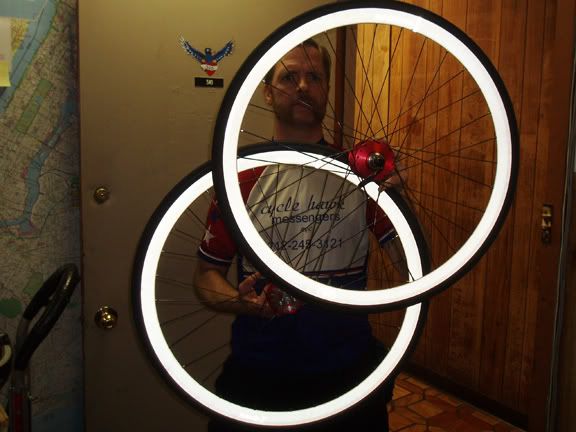
One of my jobs is working in the laboratories of Laek House, run by Ethan Benton, a local cyclist and all-around great guy. Laek House specializes in semi-technical cycling clothing, and Ethan's niche is printing patterns with retroreflective ink: the Enhanced Light Visibility System. Shine a light, see the bright.
The particularly cool innovation he's made is applying a retroreflective treatment to Velocity Rims - see photos here and video here.
The rims are a great choice for bikes with hub- or disc-braking systems (rim brakes will ruin the treatment). They are incredibly bright, and given the dangers inherent in riding in and around the city, extra visibility is always safer.
I've been working with Ethan, treating Velocity rims with the retroreflective application, so to be clear, this post is obviously a plug for the Laek House/Velocity ELVS rims. They are a smart product and deserve exposure. Check them out! You can order them through your local bike shop, which can place an order from Velocity or from Quality Bicycle Products.
Monday, November 24, 2008
H Plus Son rim failure
 Do you know what that is? That's a picture of a bad component going badly. The story is here, but the abridged version is: some kids were riding on poorly made rims, and one failed impressively.
A few months ago, an unheard-of company called H Plus Son started making deep dish aluminum rims marketed toward the fixed gear crowd. The rims are an even Deeper V for the crowd who enjoys matching accessories on their street-fixes.
Since H Plus Son's rims were only made in 32 and 36 holes, I speculated that they weren't made to be aerodynamic, but rather that they were just made to be a bigger rolling surface to match to your toestraps or grips or saddle - or whatever. Had they made rims with 20, 24, or 28 holes, I would have considered lacing up one to a front wheel for track use.
H Plus Son also boasted that they're lighter than Velocity's Deep V, which is known to be something of an anchor. But what happens when you make aluminum thinner, longer, and lighter? Stories of rim sidewall failure are surfacing already, which actually doesn't surprise me as much as the fact that internet forums are somehow already calling these rims "durable" - presumably because they're riding the coattails of the Deep V's only arguably deserved reputation.
The lesson here is that companies with no reputation who surf trend waves into style scenes should be viewed with skepticism until they prove otherwise. Admirable performance over prolonged use is the proper vetting process when new bits and pieces hit the market. To jump to claims of durability and performance is, well, a bad choice.
Photo and inspiration from Flickr user ganring, with thanks to John Prolly for the link.
EDIT: Update - more information from the event; generous skepticism from Prolly; words of warning at Bike Albany. If I hear more stories about other manufacturers' rims failing like this because a tube blows, well, I would back off a bit. But I haven't. That's not to say that it doesn't happen - I'd be learning something.
Monday, November 3, 2008
Wine, cheese, and bearing grease.
Cycling is on the rise. To hear about greying locals talk about the sport twenty, thirty, or forty years ago, it was a blue-collar sport. Al Toefield was a cop who managed Olympic Teams, got the Kissena Velodrome built, and founded the Kissena Cycle Club; David Walker was a cop too, working in community relations, who started one of New York City's biggest and most enduring races, the Harlem Skyscraper Classic Criterium. Pete Senia, it seems, organized most of the races in the 70s and 80s that laid the foundation for the cycling scene. I hear stories of these men driving vans full of young, aspiring racers - just kids - to the races in the pre-dawn hours of the morning. The scene consisted of a lot of dedicated, working-class men, a lot of immigrants. Circling Prospect Park on a Saturday afternoon, there are still groups of older Caribean men, and mustachioed Latino men, riding bikes from the 70s and 80s - Nuovo Record, downtube shifters - wearing faded colors, muted kits from bygone days.
The working-class flair that local bicycle racing had matches the technology from the time - when you're talking about a lugged steel bike with 32-spoked wheels and downtube shifters, there's really not a huge technological gap between entry level and high-end (leaving out, of course, the 1970s era Bike Boom's drive to create cheaper and cheaper frames and components). Sure, there were ways to ramp up the cost of a bike - get the frame custom made, rely on Cinelli and Campagnolo parts - but at the end of the day, the manufacturing process and the final product between basic and bling were going to look a lot alike.
These days, the price-to-quality graph looks a lot more exponential - the higher you climb, the faster the prices increase, and the less you get for these increases. Campagnolo's new Super Record 11 groupset - cranks, cogs, front and rear derailleurs, brake/shifter levers, and brakes - cost upwards of $2,000, while last year's midlevel groupset, Veloce, sells for around $600. One can get a great frameset for well under a thousand dollars - indeed, just several hundred if you're looking for somethins used - but high-end, specialty carbon fiber framesets can readily run to several thousand dollars, even climbing over the $10,000 mark. The higher up on the scale you go, you pay more and more for smaller and smaller improvements in performance, quality, or manufacturing - a rapidly declining value system.
Ironically, the growing popularity of cycling is turning it into a more exclusive sport. Case in point - I was recently at an event featuring one of the world's greatest cyclists. As the event's attendants inconspicuously crowded around and waited for a pin-sized gap in the conversation so that they could speak to (to, not with) a consistent high finisher in the Paris-Roubaix, the conversation somehow turned to high finance, and almost everybody in this circle - barring myself, a journalist, and Big George Hincapie - chimed in. Not just everybody bearing an opinion about the collapse and the bailout - instead, it seemed that everybody present was in the industry. "Oh, so you must know so-and-so at Big Firm, then." These are the consumers in the new cycling industry, an industry of "it goes to eleven," of this year's model, of custom carbon fiber, of powermeters and high-end aero wheels for the casual racer.
Threads on the internet asking when you know your frame is obsolete. Though people know that while the industry churns out "improvements" each year, the bike that you bought two, four, or ten years ago is still just going to rely on the juice that's in your legs - and yet, the industry plows on and people buy the bikes with the newest graphics. Friends, it's an economy of wine, cheese, and bearing grease, but unlike wine and cheese, I fully plan to turn this to our advantage by looking at the resale markets of so-called "obsolete" components.
The working-class flair that local bicycle racing had matches the technology from the time - when you're talking about a lugged steel bike with 32-spoked wheels and downtube shifters, there's really not a huge technological gap between entry level and high-end (leaving out, of course, the 1970s era Bike Boom's drive to create cheaper and cheaper frames and components). Sure, there were ways to ramp up the cost of a bike - get the frame custom made, rely on Cinelli and Campagnolo parts - but at the end of the day, the manufacturing process and the final product between basic and bling were going to look a lot alike.
These days, the price-to-quality graph looks a lot more exponential - the higher you climb, the faster the prices increase, and the less you get for these increases. Campagnolo's new Super Record 11 groupset - cranks, cogs, front and rear derailleurs, brake/shifter levers, and brakes - cost upwards of $2,000, while last year's midlevel groupset, Veloce, sells for around $600. One can get a great frameset for well under a thousand dollars - indeed, just several hundred if you're looking for somethins used - but high-end, specialty carbon fiber framesets can readily run to several thousand dollars, even climbing over the $10,000 mark. The higher up on the scale you go, you pay more and more for smaller and smaller improvements in performance, quality, or manufacturing - a rapidly declining value system.
Ironically, the growing popularity of cycling is turning it into a more exclusive sport. Case in point - I was recently at an event featuring one of the world's greatest cyclists. As the event's attendants inconspicuously crowded around and waited for a pin-sized gap in the conversation so that they could speak to (to, not with) a consistent high finisher in the Paris-Roubaix, the conversation somehow turned to high finance, and almost everybody in this circle - barring myself, a journalist, and Big George Hincapie - chimed in. Not just everybody bearing an opinion about the collapse and the bailout - instead, it seemed that everybody present was in the industry. "Oh, so you must know so-and-so at Big Firm, then." These are the consumers in the new cycling industry, an industry of "it goes to eleven," of this year's model, of custom carbon fiber, of powermeters and high-end aero wheels for the casual racer.
Threads on the internet asking when you know your frame is obsolete. Though people know that while the industry churns out "improvements" each year, the bike that you bought two, four, or ten years ago is still just going to rely on the juice that's in your legs - and yet, the industry plows on and people buy the bikes with the newest graphics. Friends, it's an economy of wine, cheese, and bearing grease, but unlike wine and cheese, I fully plan to turn this to our advantage by looking at the resale markets of so-called "obsolete" components.
Tuesday, September 30, 2008
Bicycle Consumption
I have a friend from my more torn-clothes punk-rock past; I fear her reproach. She lives half in my head and half in the real world - which to say it's entirely possible that I'm imagining the things that she would say, engaging in too much speculation. That I'm using her as a way to externalize my conscience.
We discovered bikes together at the university bike coop, taught each other the hammer-and-duct-tape method of bike mechanics, rode mountain bike beaters around and locked up to street signs and dumpstered miscellaneous parts and frames and pieced together our first fixed gears and, above all, reveled in our bike culture of putting to use the cast-offs from a recklessly wasteful society and building a means of affordable, egalitarian, and secretly subversive transportation. Yes, what I'm trying to say was that those first bikes were indeed pipe bombs.
What would she say now? What would she say to my pretty-but-beat-up classic Italian track bike (with Campy 151 cranks and vintage Zeus hubs)? And what would she say about my aluminum-and-carbon frame that I use exclusively for racing at the track?
There is an inherent strain of consumerism underlying much of cycling culture. This came as a surprise to me, as my main exposure to bike culture was noting that every poor kid in that faded industrial city in New England where I lived after college had a beat-up BMX bike that they'd ride around town, popping and holding huge wheelies. But in New York City, I had easy access to just-out-of-college kids spending whatever didn't go to their student loans on a new frame here, a new wheelset there. NJS this, Italian that. And meanwhile we've got the cyclists who live proximal to Central Park and trot out their Colnagos, Cervelos, and Litespeeds (oh my!) on the weekends, meandering the loop at 18 mph only semi-aerodynamically tucked onto their HED aerobars, looking for all the world like that kid you knew in high school who decided he wanted to learn guitar so went out and got a way-sweet Les Paul and a 50-watt tube amp and struggled to contort his fingers into a bar chord. Or the middle-aged, masters-level racers who show up to Kissena for the first time - "I'm just trying out track racing since I've been having a hard time not getting dropped at Floyd Bennet Field" - with their bikes wearing a new set of Zipp 808s.
Why, my friend would be asking me, would you even step close to that? Why do you have three fixed-gear bikes? (But I don't! One fixed, one track bike, and one extra track frameset...) You can really stick to your ideals and pare down your stable to one or two bikes, can't you?
Oh, right. This isn't her telling me this, it's me telling me this.
I have answers, and they're answers about how to resist consumerism while still being a bike geek. In these uncertain times, in this uncertain country, everybody spends money and everyone has their priorities. While everything is relative, having a hobby isn't indicative of conspicuous consumption (having several hobbies on the purchase scale of bikes might be, however). You work for your money and you spend it on things you like. Some people buy nicer food and some people rely on six meals a week of rice and beans. Some pay rent, some squat. Some pay off their student loans faster. Some people drink a lot. Some people give everything they don't need to people who need it a lot more.
Some people buy right to the top, buy the fanciest wheels for their new toy, go through framesets like they're trying on clothes for the high school dance. Some amateurs buy professional-level gear. I think that's ridiculous but can't say I wouldn't mind owning some of that gear.
Of the six frames I've owned in the past three years, one was bought new - my first, a tough steel all-around commuter fixed gear which I still own and ride. The others have all been used - very well used, in fact, without exception. I think hard about what bike bits I want and need, I consider alternatives, I make plans and I drop them. I buy used; I patiently wait for good deals, and sometimes I impulsively buy things I don't really need. I sell stuff from my parts bin - usually to friends, with prices falling between "good" and "I'm doing you a favor."
So I'm not part of it all - not entirely. Or I'm as much not a part of it as I am a part of it. Or, there's no such thing as being part of it or not being part of it.
Look: don't buy the best thing you can get. You might not need it. Don't buy everything you want - you might have some redundant bike issues. Buy smart and buy restrained and make good financial decisions. Buy used, for goodness sake - I'm not too confident in the environmental effects of all that carbon production, that aluminum production, the chroming and painting processes. Buy things that will last you. I think the measure of unhealthy consumption might not be what you have, but what you go through.
If I were living somewhere else, with different habits, I might have one bike - some steel cyclocross bike with a carbon fork (and a steel one in the closet), that I could put some slick tires on and use in the occasional road race, or throw a rack on and go for a light tour.
No doubt that day will come eventually, but it's not here right now.
Until then, I'm going to enjoy my hobby, and spend less on my bikes than so many people do on electronics, clothes, rent in ugly gentrified neighborhoods, drugs and alcohol, cars and other shitty forms of transportation, and so forth.
We discovered bikes together at the university bike coop, taught each other the hammer-and-duct-tape method of bike mechanics, rode mountain bike beaters around and locked up to street signs and dumpstered miscellaneous parts and frames and pieced together our first fixed gears and, above all, reveled in our bike culture of putting to use the cast-offs from a recklessly wasteful society and building a means of affordable, egalitarian, and secretly subversive transportation. Yes, what I'm trying to say was that those first bikes were indeed pipe bombs.
What would she say now? What would she say to my pretty-but-beat-up classic Italian track bike (with Campy 151 cranks and vintage Zeus hubs)? And what would she say about my aluminum-and-carbon frame that I use exclusively for racing at the track?
There is an inherent strain of consumerism underlying much of cycling culture. This came as a surprise to me, as my main exposure to bike culture was noting that every poor kid in that faded industrial city in New England where I lived after college had a beat-up BMX bike that they'd ride around town, popping and holding huge wheelies. But in New York City, I had easy access to just-out-of-college kids spending whatever didn't go to their student loans on a new frame here, a new wheelset there. NJS this, Italian that. And meanwhile we've got the cyclists who live proximal to Central Park and trot out their Colnagos, Cervelos, and Litespeeds (oh my!) on the weekends, meandering the loop at 18 mph only semi-aerodynamically tucked onto their HED aerobars, looking for all the world like that kid you knew in high school who decided he wanted to learn guitar so went out and got a way-sweet Les Paul and a 50-watt tube amp and struggled to contort his fingers into a bar chord. Or the middle-aged, masters-level racers who show up to Kissena for the first time - "I'm just trying out track racing since I've been having a hard time not getting dropped at Floyd Bennet Field" - with their bikes wearing a new set of Zipp 808s.
Why, my friend would be asking me, would you even step close to that? Why do you have three fixed-gear bikes? (But I don't! One fixed, one track bike, and one extra track frameset...) You can really stick to your ideals and pare down your stable to one or two bikes, can't you?
Oh, right. This isn't her telling me this, it's me telling me this.
I have answers, and they're answers about how to resist consumerism while still being a bike geek. In these uncertain times, in this uncertain country, everybody spends money and everyone has their priorities. While everything is relative, having a hobby isn't indicative of conspicuous consumption (having several hobbies on the purchase scale of bikes might be, however). You work for your money and you spend it on things you like. Some people buy nicer food and some people rely on six meals a week of rice and beans. Some pay rent, some squat. Some pay off their student loans faster. Some people drink a lot. Some people give everything they don't need to people who need it a lot more.
Some people buy right to the top, buy the fanciest wheels for their new toy, go through framesets like they're trying on clothes for the high school dance. Some amateurs buy professional-level gear. I think that's ridiculous but can't say I wouldn't mind owning some of that gear.
Of the six frames I've owned in the past three years, one was bought new - my first, a tough steel all-around commuter fixed gear which I still own and ride. The others have all been used - very well used, in fact, without exception. I think hard about what bike bits I want and need, I consider alternatives, I make plans and I drop them. I buy used; I patiently wait for good deals, and sometimes I impulsively buy things I don't really need. I sell stuff from my parts bin - usually to friends, with prices falling between "good" and "I'm doing you a favor."
So I'm not part of it all - not entirely. Or I'm as much not a part of it as I am a part of it. Or, there's no such thing as being part of it or not being part of it.
Look: don't buy the best thing you can get. You might not need it. Don't buy everything you want - you might have some redundant bike issues. Buy smart and buy restrained and make good financial decisions. Buy used, for goodness sake - I'm not too confident in the environmental effects of all that carbon production, that aluminum production, the chroming and painting processes. Buy things that will last you. I think the measure of unhealthy consumption might not be what you have, but what you go through.
If I were living somewhere else, with different habits, I might have one bike - some steel cyclocross bike with a carbon fork (and a steel one in the closet), that I could put some slick tires on and use in the occasional road race, or throw a rack on and go for a light tour.
No doubt that day will come eventually, but it's not here right now.
Until then, I'm going to enjoy my hobby, and spend less on my bikes than so many people do on electronics, clothes, rent in ugly gentrified neighborhoods, drugs and alcohol, cars and other shitty forms of transportation, and so forth.
Subscribe to:
Posts (Atom)


 Posts
Posts