New York City is a great place for bike racing. In the middle of the season it's pretty easy to race three or four times a week - Tuesday's Floyd Bennet Series, Wednesday at the Kissena Velodrome, Thursday up in Rockleigh, NJ, and Saturday or Sunday in Prospect Park or Central Park.
However, when we race bikes in New York City, our tires run over the same pavement over and over again. Floyd, the Parks, Grant's Tomb in the spring, Harlem in the summer. Do the guys who've been doing this for years and years get bored?
That's why it was particularly cool that Kissena's race director Charlie Issendorf managed to throw two races (1/2/3 and 3/4) on Governor's Island this summer, in seperate events. The course was a fun 1.4mile crit with two hard corners and a big sweeping bend around the southern side of the island that left people fighting for shelter from the strong winds blowing in from the harbor.
It made me think (and perhaps daydream) about other places to throw races in New York City. Of course there was StatenCX last year, down in Staten Island. I wonder if the Parks Department could be smooth-talked into allowing a whole NYC Cyclocross series - Wolf's Pond Park, Kissena Park, Alley Pond Park, Van Cortlandt, Randall's Island (how could you not?)...
What about a crit in downtown Manhattan? What about a major road race that starts on the West Side Highway or the FDR, goes over the George Washington Bridge, and sends racers on a course up the Palisades before returning to the city?
In fact, why stop there? Why not a Pro/Am stage race on the East Coast? Some mountain stages up around Lake Placed, then heading into Vermont and New Hampshire, obviously a hilltop finish on Mount Washington, some long flat stages down through Massachusettes, a time trial or two through Connecticut, and finishing with a boisterous crit in New York City.
Maybe I'm thinking a little bit too big, or too fast. Or maybe I'm a vissionary. Charlie, can you start work organizing that stage race?
Showing posts with label the cycling world. Show all posts
Showing posts with label the cycling world. Show all posts
Saturday, August 15, 2009


Thursday, August 6, 2009
Squarebuilt
Squarebuilt bicycles are among the nicest handmade bikes coming out of New York City (with a nod to Johnny Coast, who's been doing it a bit longer). I've had my hands a few of the frames made in this little shop, and they sure are lovely.
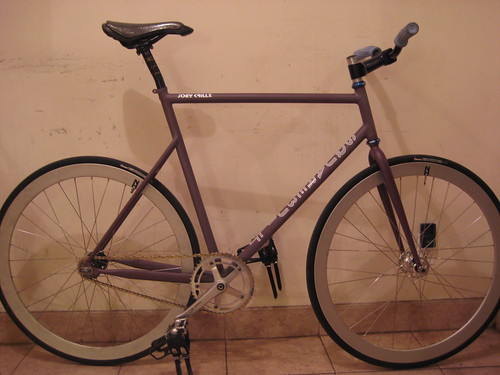
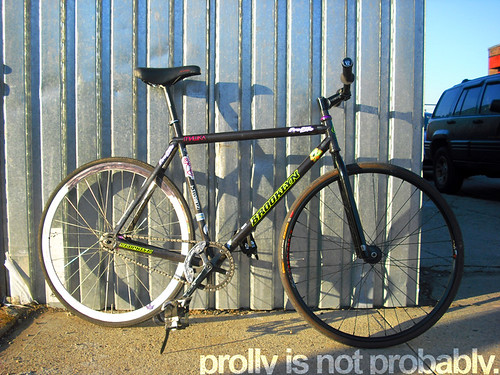
Apparently, a few of them are more than a little bit cursed. Messenger bikes are footsoldiers in a very odd war, and Joey Krillz's bike (before and after) is the latest fatality. Fortunately he's fine - the bike was smashed by a truck while locked up, which is kind of like surviving the sinking of the Titanic only to die of pneumonia on the Carpathia. Regretably, it's not the first. Krillz's colleague Drew has had some ill tides wash over his Squarebuilt (before and after), and said, "Squarebuilt bicycles are the kamikaze pilots of the custom frame world. They burn bright, make their masters proud and die young in horrifying, senseless collisions."
Apparently, a few of them are more than a little bit cursed. Messenger bikes are footsoldiers in a very odd war, and Joey Krillz's bike (before and after) is the latest fatality. Fortunately he's fine - the bike was smashed by a truck while locked up, which is kind of like surviving the sinking of the Titanic only to die of pneumonia on the Carpathia. Regretably, it's not the first. Krillz's colleague Drew has had some ill tides wash over his Squarebuilt (before and after), and said, "Squarebuilt bicycles are the kamikaze pilots of the custom frame world. They burn bright, make their masters proud and die young in horrifying, senseless collisions."
Tuesday, August 4, 2009
Theft Recovery
Nigh on two years ago, NYTimes' City Room blog published a piece on our local cycling community's heroic stolen-bike-recovery network. The mover and shaker behind the recovery that the Times profiled was Jack Crank, an all-around ne'er-do-well of No Gods, No Vegetables, and he's done it again.
This time it was Dan Bones's Waterford, a lovely bike that I hadn't even had a chance to drool over before it was nicked from his office. He had a run of particularly evil luck:
so! this brings the total over the past five months up to 2 broken collarbones [separate incidents], one stolen front wheel, one fucked up fork, one broken set of road bars, one stolen rear light, one broken rear wheel, one completely destroyed bike and one complete stolen bike.
But Jack saw the bike in a shop almost a year after it was stolen, made a few phone calls, and it was recovered - with the help and cooperation of the shop and the gracious new owner, who had apparently bought it for a song.
The amazing thing is that in the past few years, this has happened over and over again. Kelsey's 'cross bike was recovered when the new owner (who had bought it for way too cheap) brought it to a shop; Julie's workbike was recovered at McCarren Park the same day it was stolen while she was working; Ric's KHS was recovered almost a year after it was lifted after being spotted around town several times; Graham's Fuji had been seen around Canal St and was eventually recovered; Continuum assisted in several East Village recoveries. That's what recent memory uncovers.
From what I've seen, the following are crucial to bike recoveries.
1. Publicizing, posting pictures on the local cycling message board
2. Contacting friendly workers at bike shops who will keep their eyes out
3. Mass text messages to the people you know.
4. Knowing hotspots where a bike may be taken for a quick resale in the neighborhood where it was stolen.
Something to keep in mind; hopefully you won't ever have to use the info.
This time it was Dan Bones's Waterford, a lovely bike that I hadn't even had a chance to drool over before it was nicked from his office. He had a run of particularly evil luck:
so! this brings the total over the past five months up to 2 broken collarbones [separate incidents], one stolen front wheel, one fucked up fork, one broken set of road bars, one stolen rear light, one broken rear wheel, one completely destroyed bike and one complete stolen bike.
But Jack saw the bike in a shop almost a year after it was stolen, made a few phone calls, and it was recovered - with the help and cooperation of the shop and the gracious new owner, who had apparently bought it for a song.
The amazing thing is that in the past few years, this has happened over and over again. Kelsey's 'cross bike was recovered when the new owner (who had bought it for way too cheap) brought it to a shop; Julie's workbike was recovered at McCarren Park the same day it was stolen while she was working; Ric's KHS was recovered almost a year after it was lifted after being spotted around town several times; Graham's Fuji had been seen around Canal St and was eventually recovered; Continuum assisted in several East Village recoveries. That's what recent memory uncovers.
From what I've seen, the following are crucial to bike recoveries.
1. Publicizing, posting pictures on the local cycling message board
2. Contacting friendly workers at bike shops who will keep their eyes out
3. Mass text messages to the people you know.
4. Knowing hotspots where a bike may be taken for a quick resale in the neighborhood where it was stolen.
Something to keep in mind; hopefully you won't ever have to use the info.
Saturday, August 1, 2009
I am not Bike Snob...
 ...but a Craigslist ad for a used Bianchi Pista that says, Busted fork is very fixable makes it hard to avoid commentary.
In the interest of brevity: I would speculate that the fork in that photo is outside of the range of fixability, and it's probably hard to sell something that busted-looking.
Tuesday, June 2, 2009
What to do after a collision?
This morning, on my way to work, I happened upon a collision scene. A schoolbus with a very mangled bicycle underneath it, and a scraped and bloody rider. The driver had, apparently, failed to check his mirrors before turning, and the rider got hooked. Fortunately she fell off before the bike got sucked under the bus's wheels. She was scraped up but wasn't majorly injured. I called 911 anyway, to get the police to come so that she could file an accident report. Well, because of either standard protocol or not hearing "no major injuries," they dispatched an FDNY fire truck and ambulance, out of which tumbled six or eight people who proceeded to immobilize her spine.
Her bike is locked up on the SW corner of Bedford and S.10th street in Brooklyn, and if you see it, take it as a reminder to stay safe and smart out on the streets.
If you get hit, even if it's minor, call the police and file a police report. It serves as an official documentation of the collision (I avoid using the word "accident"), which you absolutely need if you want to follow up with the driver's insurance company. That is, if you want them to pay your medical bills or replace your bike. You never know what will hurt after the adrenaline wears off, and you never know what's broken that you won't see on the first pass over the bike. Maybe your frame is cracked. Maybe you've got a minor concussion. In New York, the car driver's insurance company has the responsibility for covering those things. File a police report and then submit a No Fault Claim with the insurance company.
There's lots more information floating around. I'd start by checking out the Know Your Rights manual, which is aimed at messengers. Also, Transportation Alternatives provides a list of cyclist-friendly lawyers, should you need one.
If you're going to be on the street a lot, you entertain the possibility that you'll get hit by a car. Know what to do so that you're not left in the cold, with a broken body and a broken bike. Knowledge is power.
Her bike is locked up on the SW corner of Bedford and S.10th street in Brooklyn, and if you see it, take it as a reminder to stay safe and smart out on the streets.
If you get hit, even if it's minor, call the police and file a police report. It serves as an official documentation of the collision (I avoid using the word "accident"), which you absolutely need if you want to follow up with the driver's insurance company. That is, if you want them to pay your medical bills or replace your bike. You never know what will hurt after the adrenaline wears off, and you never know what's broken that you won't see on the first pass over the bike. Maybe your frame is cracked. Maybe you've got a minor concussion. In New York, the car driver's insurance company has the responsibility for covering those things. File a police report and then submit a No Fault Claim with the insurance company.
There's lots more information floating around. I'd start by checking out the Know Your Rights manual, which is aimed at messengers. Also, Transportation Alternatives provides a list of cyclist-friendly lawyers, should you need one.
If you're going to be on the street a lot, you entertain the possibility that you'll get hit by a car. Know what to do so that you're not left in the cold, with a broken body and a broken bike. Knowledge is power.
Wednesday, May 27, 2009
ELVS rims
 I've recently gone from underemployment to overemployment, and my schedule fits together like tetris pieces. That's part of the reason why a wide-open morning for a lovely ride - fast and hard in parts, but sans-computer and without a hard end time - is such a welcome rarity.
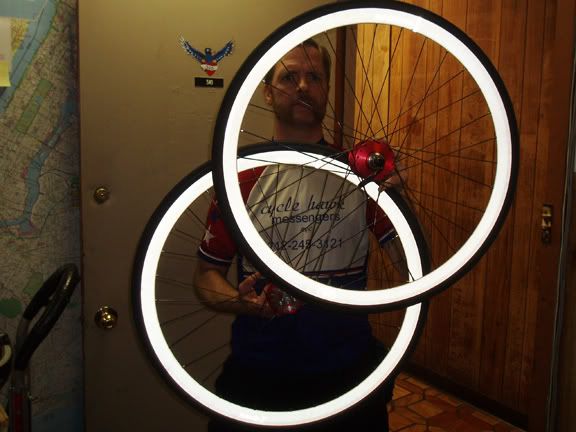
One of my jobs is working in the laboratories of Laek House, run by Ethan Benton, a local cyclist and all-around great guy. Laek House specializes in semi-technical cycling clothing, and Ethan's niche is printing patterns with retroreflective ink: the Enhanced Light Visibility System. Shine a light, see the bright.
The particularly cool innovation he's made is applying a retroreflective treatment to Velocity Rims - see photos here and video here.
The rims are a great choice for bikes with hub- or disc-braking systems (rim brakes will ruin the treatment). They are incredibly bright, and given the dangers inherent in riding in and around the city, extra visibility is always safer.
I've been working with Ethan, treating Velocity rims with the retroreflective application, so to be clear, this post is obviously a plug for the Laek House/Velocity ELVS rims. They are a smart product and deserve exposure. Check them out! You can order them through your local bike shop, which can place an order from Velocity or from Quality Bicycle Products.
Giovani Pettenella frame and story
 A curious frame is for sale on Craigslist and eBay.
A local bike buddy has apparently met the builder, and shared the following story:
Pettenella is an amazing guy. I spent some time at his shop in Milano and he was kind enough to send me home with an old cycling cap bearing his name. Famously, he once help a track stand for 65 minutes in a match spring under oppressive Milano summer sun. His opponent, exhausted and dehydrated, fainted and collapsed on his bike, sliding down the banks of the famed Velodromo Vigorelli. Vanni waited for the officials/medical staff to check out the unconscious rider (while still holding his track stand)...then took a lap to validate his victory and take the 1968 Italian National Championship.
A great story. The fact that Pettenella's competitor was willing to trackstand to the point of fainting rather than cede control of the early part of the sprint speaks volumes - about what, however, I am not sure.
Tuesday, May 19, 2009
Giro D'Italia: Stage 9 Neutralization
The internet world is abuzz with talk over the peloton's neutralization of Stage 9 of the Giro D'Italia. Pedro Horrilo's crash into a 150 foot ravine during Stage 8 prompted them to organize their concerns about the safety of the course. Apparently, Stage 9's kermis-like circuit race had parked cars still on the course, among other hazards. I can't blame them. Yeah, they're the best in the world riding one of the most competitive stage races in the world. They don't need to harden the fuck up. They've already done that. Probably while you were arguing on the internet. Okay, okay. Probably while we were arguing on the internet.
What they're doing now is refusing to let their having hardened the fuck up be turned into an unnecessarily dangerous game of puppetry, a sport of profit that places the alleged kings in danger for heightened entertainment value that strips them of honor should they opt out. Basically they're refusing to be rodeo clowns, NASCAR drivers, or prizefighters, and can you blame them?
What they're doing now is refusing to let their having hardened the fuck up be turned into an unnecessarily dangerous game of puppetry, a sport of profit that places the alleged kings in danger for heightened entertainment value that strips them of honor should they opt out. Basically they're refusing to be rodeo clowns, NASCAR drivers, or prizefighters, and can you blame them?
Wednesday, March 18, 2009
Carbon Fiber
 I've been reading a blog called Busted Carbon - or, rather, I've been looking at the pretty pictures. By focusing its content on carbon, the blog perpetuates the easy inaccuracy that carbon is more fragile than other materials. The reality is a bit more nuanced - steel and aluminum both have a long history of failing for various reasons. I file carbon-fearmongering under "missing the point." Nonetheless I enjoy Busted Carbon.
Additionally, realizing that both Calfee and Road Runner Velo will repair carbon frames for a fraction of their replacement cost has made me think about carbon as being between aluminum and steel in the disposable-spectrum - with steel being on the more surviving end for its ability to be bent back into shape. I'd rather not have the longevity of my bike be determined by one unfortunate crash. I'll have to check with Gui and Ethan about their carbon-repairing experience.
When you pack on the miles, certain realities emerge: you will wear out parts. You may break parts. You increase the likelihood that you will crash and severely damage bike and body. This leads me to wonder why I see so much expensive gear in Cat 5 races, where due to inexperience level and the race situation, crashes are probably more likely to occur. Maybe other people are just more comfortable spending a lot of money than I am; maybe they think that their Zipp wheels will be around for a long, long time. Maybe they think that they need that stuff in order to be competitive. That would be the biggest shame of the bunch.
(image above from Busted Carbon)
Thursday, March 12, 2009
Frame Design: Fork Rake, Head Tube Angle, Trail
 In the part of the cycling world that's perpetuated on the internet - message boards and such - there's a lot of hipster-bashing, centered around ubiquitous photos of very stylish bikes featuring some very nonsensical tradeoffs in build/component choices. A surprising amount of Bike Snob's blog is about these bikes, so I assume you can forgive me for not going into detail. However, for all the talk of hipsters who don't understand how their bicycles work I see road bikers making plenty of silly decisions that seem to stem from an ignorance about the way that bikes work.
One of my pet peeves is misunderstandings about front end geometry: head tube angle and fork rake. Maybe it's because in the fixed gear scene there's a lot of neophyte fretting about "true track geometry" and an infectuous perpetuation of the terms "tight" and "twitchy" without real meaning or understanding behind them. Meanwhile I've heard plenty of road folks who greatly misunderstand the differences between front end design of time trial bikes and road bikes. While I don't claim to be an expert I do think it's important to share good information when it's widely available. And so, some of my favorite resources:
Best introduction I've found is the An Introduction to Bicycle Geometry and Handling, by CHVNK. Dave Moulton's piece is also very well-explained. In particular he narrates the changes made to frame design (with regards to front end design: head tube angle, rake, and trail) in the 50s, from the long-wheelbase bikes of the 1940s and before to the more contemporary-looking bikes with tighter geometry that became the status quo in the 60s. From Urban Velo is a piece by Don Walker: The Truth About Track Geometry, which features a good bit on trail and a bike's handling. And, if you want to run the calculations for your own bike, you can do so with this Excel spreadsheet from Anvil Bikeworks.
The boildown is that head tube angle and fork rake work against each other in order to reach an equilibrium, a sweet spot of trail measurement (60mm, according to Don Walker). Overcompensating one because of a lack of the other is counterproductive: putting a road fork on a track bike with a steep headtube angle will make the handling less stable - the higher-rake fork reduces the trail measurement. A "road" fork doesn't make a bike's handling more stable - it will make it less self-correcting. Putting a low-rake fork in order to tighten up the front end of a bike with a slack head tube, rather than bringing a bike's handling closer to neutral, will push it toward very-high-rake, sluggish handling. Which is fine, if you want a road bike that handles like a cruiser. I learned this first hand, picking up a carbon fork for my every-day bike with a 72deg headtube. The fork turned out to have 28mm of rake: too low to neutralize the handling - it was sluggish.
Don't make the mistake of making uninformed decisions about this stuff. You don't have to know everything about how your bike works in order to ride it, but if you're going to change things and make product decisions, be discerning about what information you file away as reliable in your head. Not everybody posting on Bikeforums, nor every shop employee, gets everything right all the time.
For me, soaking up information about this stuff is part of what makes cycling beautiful. When I lean my bike into a corner, I know that there's a very elegant design that's practically making the bike handle itself. Furthermore, knowing how and why your bike works the way it does just might make you a better rider when the going gets rough...
 (closing image courtesy of Cycling Art Blog)
Saturday, February 21, 2009
Bike Polo
 Photo from Doug D.
I thought I was a good bike handler until I watched New York City's bike polo players in action. If you think that trackstanding at a stoplight on your road bike is hard, wait until you try reaching over your handlebars with a mallet, straining to reach the ball, while turning to avoid the wall of the court as an opposing player shoulders you and tries to swat your mallet away from the ball. Needless to say, the learning curve is such that it may be several games before you manage a shot on goal.
Bike polo has grown a lot in the past several years. I remember, four years ago, getting invited to a pick-up game somewhere on the East River. Two years ago, it really took off, and Sunday games drew crowds of bikers who would hang out, drink beer, and enjoy the day in Chinatown. These days, cities host tournaments for out-of-towners - there's a surprising National element to the game, complete with high-caliber rivalries and all. Of course, it's also got plenty of mainstream attention - an article in the New York Times and, I kid you not, a scene in a Cameron Diaz/Ashton Kutcher movie. This summer, my own Nana mailed me an article about bike polo from a newspaper in the small Vermont town where she lives, with a short note at the top: "This looks like something you'd be in to!"
It's been fun watching this sport develop, try and figure out the extent to which it should articulate its rules, while also watching the polo culture develop with a bit of tension between the developing athletecism and the desire to make polo welcoming for people of all skill levels. The folks at the helm are a pretty good bunch and it seems that polo's rising profile hasn't disrupted their ability to enjoy themselves (unlike what may have happened with alleycat racing). It's been a while since I've swung by the polo grounds to hang out and watch the play, and even longer since I've played, but maybe in the next week or two I'll get out there. Courtesy of NYC Bike Polo, here's a video of poloistas in action. Enjoy!
Thursday, February 12, 2009
Marty Nothstein
 I read this Cycling News interview with Marty Nothstein, and found it pretty interesting. If you watch track sprint races from the 1990s, Marty Nothstein is the enormous dude in the front at the finish line. He's got a couple palmares, including being the National sprint champ from '96 to '01; here he is dominating the 1996 Olympic trials at the Trexlertown Velodrome (the 5 parts of that video are pretty enjoyable).
I like that interview with Nothstein because it spins into some geekery, and that's satisfying to me. It's fun to learn that Marty was sprinting on a 50x14 gear - a huge gear for track racing, but incidentally, a fairly small gear for road sprintig where riders will be pounding a 53x13, 12, and maybe even 11 (but if roadies think that a 50x14 is a small gear, try starting your sprint in that gear, from a standing start!). He also shares his preferred crank length with us - 167.5mm for sprint events.
I also like that we get a perfect glimpse into the significant ego of the sprinter:
CN: Six hundred meters out, Marty Nothstein, or Lance Armstrong?
MN: In a sprint?
CN: Yeah.
MN: After how long?
CN: A Classic.
MN: He's done.
CN: Six hundred meters out, Marty Nothstein or Mario Cipollini?
MN: Cipo's done. No problem.
Something in me doubts that a beefcake like Marty, a pure sprinter, would even be with Lance Armstrong or Cipolllini with 600 meters left in a Classic. But there's Marty, pretty confident in his ability to destroy everybody else. The sprint is certainly a discipline that just attracts or perhaps manufactures big egos - I wonder to what extent that's due to the fact that, unlike many other cycling events, sprints are very individual events. The match sprint is (usually) a one-on-one event. There is a lot of room for tactical manipulation of the race but there is very little room for nonpersonal variables to sneak in and effect the outcome of the race - whereas, in road cycling, so many racers need to be humbled by their vulnerability to the elements, the terrain, a staple in the road, or a team that's just too damn strong. To win a road race, the stars have to be alligned, the cards shuffled, the tires intact, and maybe you've got to be the strongest rider on the road.
In a track sprint, you've only got to be the strongest rider on the banking. So I can see where the ego comes in to play. Oh, right, and there's this:
MN: I need to win.
CN: Why?
MN: I just plain out like it! There's nothing better.
Need more be said?
Rumor on the street is that he'll be around to teach some higher-level training sessions at the Kissena Velodrome this season. I'll have to check that out.
Closing the post with a fun fact: the GT that Marty is mounting here was actually made by Trimble Cycles, developed and built by the uncle of a teammate of mine. Other Trimble designs were incorporated into Kestrel bicycles, but my favorite Trimble design due to its sheer outlandishness is the "sailbike," an aero tt/tri bike from the 80s. Crazy!
Saturday, January 17, 2009
On Doping / Millar's Story
 Everybody knows that there's doping in cycling. There always was, and while there may not always be, it's not just some modern evil. After all, Tom Simpson died on the road up Mt Ventoux (partially) because of amphetamines and alcohol.
Via VeloGoGo I stumbled on this short video bit on David Millar. As contemplative music strums in the background, he tells the story of his entry into professional cycling as a 19-year-old, of rapidly fulfilling his dream of not only riding in the Tour de France, but winning a 16k time trial - beating Lance Armstrong by 2 seconds and getting to don the yellow jersey.
He then tells of burnout, being underconditioned (perhaps overtrained, I wonder?), and having his team take his hand and lead him toward doping. He is regretful.
It's obviously a marketing piece for Slipstream, but I really enjoyed it. It personalizes doping in the context of an extremely demanding sport. One of the things that bothers me most about doping is the witch-hunt element of it. I could barely stand the Tours de France of the past two years - I wondered if, by the time the race got to Paris, there would be any riders left after the organizers' purges. Doping may not be right but it seemed that the cure was worst than the disease. Even worse are those in the peanut gallery who take the opportunity to scream "Doper!" at the slightest provocation. I watched with dismay as a talented local racer was given a 2-year suspension last year - an ingredient in a supplement he took had just been added to the list of banned substances. Regretable, and then came the jerks sitting at their computers, firing off invectives, and generally acting as if taking supplements is worse for the spirit of the sport than being an out-and-out asshole.
"Millar's Story" is a bit of humanity in the circus. Watch it for yourself - Part 1 and Part 2 - and let me know what you think.
Saturday, January 3, 2009
Hipster Trickster Idiocy

John Prolly wrote a pretty good piece for Urban Velo magazine about fixed gear freestyling, here. John is one of the more public figures in the FIX/MX (or 700CMX) trend - using full-sized fixed gear bikes for BMX-derived trick riding.
I've been impressed at how how skill throw-downs have evolved in the past few years. When I started racing alleycat races, side events featured track bike skid competitions. There was nothing cooler than a smoothly executed one-leg-over-the-handlebar, 360-degree skid, as a legion of sweaty bike kids clutching brown-bagged beers cheer on. But the a few people started to barspin and do wheelies, and all of a sudden there was another level of grace, coordination, and control on the bike.
And, in a just over two short years, it's booming. Companies are producing barspin-able bikes and beefy components made for slamming around. John himself is adamant that he doesn't ride a track bike - this is a different monster altogether. It's not a bike repossessed for a new purpose, like a track bike ridden on the street is. It's a fixed-gear trick bike - something tough, reliable, and, most importantly, ridable. It's a new kind of bike.
There's a lot of scorn for this field, as there always is for a developing niche. "Just get a BMX bike" kind of contrasts with the track-bike orthodoxy ("death before derailleurs!") that occasionally develops. But one of the things I admire about John is that he embraces the fact that it's not about track bikes. It's about riding and being able to ride to new places, and the fact that he's so willing to experiment with new pieces of gear - some of which are god-awfully ugly according to the conventional aesthetics - says that he's more interested in the function than the form. I mean, come on! Unicrown forks are hideous, 40 spoke wheels are ridiculous, 28mm wide tires are overkill for a 125-pound weakling like myself, who can't bunnyhop something higher than a curb. Riser bars... the list goes on. I hate all those bits and pieces. And yet they make perfect sense for these new bikes, and, well, that's okay. That's just fine. In fact, it's right-on. Exactly where it needs to be, with form following function.
Considering the way that cycling scenes tend to play out, abandoning form-first mentality means abandoning silly orthodoxies, more-authentic-than-thou idiocy, and general interdisciplinary trash-talking. John just likes to go ride his bike and do wacky shit on it. In collaboration with a couple companies and a bunch of other riders they've been identifying parts and designs that can survive this (ab)use. They're not perverting any old stock of riding history, they're creating a new one, and that's a lot of fun to watch. Not just because I've always been interested in the dynamics of temporal emergence (to borrow a term from my University days, but because some of the shit that they do on bikes is really cool.
BikesnobNYC can't stop giving John a hard time, but whatever. I like what John's doing, even if can't help but roll my eyes every time I see pictures posted on bikeforums featuring a super-short stem, riser bars reaching for the sky, and a 650 wheel in a fork meant for 700s... or, in other ways, just using the wrong tool for the job. Some of this stuff makes for nonsense bikes but it doesn't mean that the whole discipline is nonsense.
I mean hey, BMX was an Olympic sport in 2008. Things change.
That's the point.
I know I've got at least a couple readers who aren't quite so familiar with the city fixed gear scene, so, I welcome your reactions. Here is a little bit more data for your research (youtube).
Thursday, December 4, 2008
Kissena regular Gabby Allong in the Daily News
 The NY Daily News has a nice piece on Kissena regular Gabriella Allong, which Kissena Track Racing also posted. And it includes an extremely bad-ass picture.
Gabby's a great racer to watch - she attacks viciously, tearing apart the race field with strong solo efforts. When she enters races where she's the only woman in the field, she does exactly the same thing - makes daring attacks early in the race to break it up and be competitive in a field full of big, powerful men, many of whom are more than twice her age.
The article mentions racism in cycling - or, at the very least, white-dominance, calling Gabby "
an anomaly in the sport of cycling: an African-American girl, competing in a sport that's marked by a prevalence of white participants." The upper levels of cycling might be dominated by white people, but to call the grassroots level white-dominated is to ignore a lot of people and perpetuate the very problem that the Daily News takes pains to point out. Reality is created by what we acknowledge and discuss.
Two interesting things to consider about cycling being white dominated: one, an essay by Malcolm Gladwell on expertise:
Sport, too, is supposed to be just such a pure meritocracy. But is it? Take ice hockey in Canada: look at any team and you will find that a disproportionate number of players will have been born in the first three months of the year. This, it turns out, is because the cut-off date for children eligible for the nine-year-old, 10-year-old, 11-year-old league and so on is January 1. Boys who are oldest and biggest at the beginning of the hockey season are inevitably the best. And so they get the most coaching and practice, and they get chosen for the all-star team, and so their advantage increases - on into the professional game. A similar pattern applies to other sports. What we think of as talent is actually a complicated combination of ability, opportunity and utterly arbitrary advantage.
And, two: an organization called The African Cyclist, training Kenyan athletes with the goal of making one of them the first black man to compete in international professional road racing. It's turned out impressive results, with two cyclists - who have been riding for less than a year - clocking times of 46 minutes up the Tour de France's legendary Alpe D'Huez. A week after their first attempt, one of them raced again and finished with a time of 42 minutes (video here, which would have placed him 11th in the 2004 Alpe D'Huez time trial in the Tour de France.
My point is that not only is cycling far less white-dominated than the Daily News might have assumed, but that it also has the capacity to be much less monoracial at the upper echelons of the sport.
It's not like I expect excellent racial politics from the Daily News, but come on, this is New York City. Cycling is only dominated by white people when all the forty year old men drive in from Long Island and New Jersey for Sunday morning Prospect Park races.
And getting back to what started this post - Congratulations to Gabby. Having an article about you in the newspaper is such an awesome thing. Best of luck in the 2009 season!
Wednesday, November 19, 2008
Route 9W
 Those of us in New York City who feel the frustration of dealing with red lights every tenth of a mile and a world-class levels of automobile congestion, there is always Rt 9W, and Nyack.
It's easy to get to. Ride up Manhattan in a leisurely warm-up pace via the West Side Bike Path or Central Park, and cross the George Washington Bridge. If you're sentimental, take a moment to appreciate the feeling of being hundreds of feet over a mile-wide river.
There, in New Jersey, is the ride for area cyclists. Oh, there are other rides and other routes of course, but Nyack is the quick and easy choice. It's as close as you can get. The road is well-paved with a generous shoulder. There are lengthy flats, a few rolling hills with short climbs and quick descents that make for enjoyable terrain.
When out there you will see other cyclists. Hordes of them. Impromptu pacelines may form amongst strangers - we exchange a few words of greeting and rely on our common language: a flick of an elbow, a sweep of the hand. If you flat, whether or not you're alone, somebody will slow and ask if you've got everything you need.
And I'm quite certain that car drivers are used to seeing so many cyclists, in groups, gaily dressed in our tight, colorful finery, that it's generally safer to ride there - even while cars fly by at 55+ mph - than it is in many other places.
So it comes with discomfort to hear the news of a terrible crash a few days ago, that left a cyclist being treated while in a medically-induced coma. Details are scarce; several days ago I had heard the rider's description in an effort to identify him.
Best wishes to Camille Savoy, and to everybody else on the road. And a reminder - carry identification and emergency contact numbers. And, among the thrill of 29 mph pacelines and 50mph descents, ride with a healthy sense of self-preservation. The fewer ghost bikes that are installed, the better.
And it should go without saying that those of you who are bi-curious in your transportation choices: when you get behind the wheel of a car, take care. Your sense of safety is dulled by your steel armor and the ease with which pressure on the pedal translates to acceleration. The people on the outside - in our neighborhoods, on our streets - are at risk.
Monday, November 3, 2008
Wine, cheese, and bearing grease.
Cycling is on the rise. To hear about greying locals talk about the sport twenty, thirty, or forty years ago, it was a blue-collar sport. Al Toefield was a cop who managed Olympic Teams, got the Kissena Velodrome built, and founded the Kissena Cycle Club; David Walker was a cop too, working in community relations, who started one of New York City's biggest and most enduring races, the Harlem Skyscraper Classic Criterium. Pete Senia, it seems, organized most of the races in the 70s and 80s that laid the foundation for the cycling scene. I hear stories of these men driving vans full of young, aspiring racers - just kids - to the races in the pre-dawn hours of the morning. The scene consisted of a lot of dedicated, working-class men, a lot of immigrants. Circling Prospect Park on a Saturday afternoon, there are still groups of older Caribean men, and mustachioed Latino men, riding bikes from the 70s and 80s - Nuovo Record, downtube shifters - wearing faded colors, muted kits from bygone days.
The working-class flair that local bicycle racing had matches the technology from the time - when you're talking about a lugged steel bike with 32-spoked wheels and downtube shifters, there's really not a huge technological gap between entry level and high-end (leaving out, of course, the 1970s era Bike Boom's drive to create cheaper and cheaper frames and components). Sure, there were ways to ramp up the cost of a bike - get the frame custom made, rely on Cinelli and Campagnolo parts - but at the end of the day, the manufacturing process and the final product between basic and bling were going to look a lot alike.
These days, the price-to-quality graph looks a lot more exponential - the higher you climb, the faster the prices increase, and the less you get for these increases. Campagnolo's new Super Record 11 groupset - cranks, cogs, front and rear derailleurs, brake/shifter levers, and brakes - cost upwards of $2,000, while last year's midlevel groupset, Veloce, sells for around $600. One can get a great frameset for well under a thousand dollars - indeed, just several hundred if you're looking for somethins used - but high-end, specialty carbon fiber framesets can readily run to several thousand dollars, even climbing over the $10,000 mark. The higher up on the scale you go, you pay more and more for smaller and smaller improvements in performance, quality, or manufacturing - a rapidly declining value system.
Ironically, the growing popularity of cycling is turning it into a more exclusive sport. Case in point - I was recently at an event featuring one of the world's greatest cyclists. As the event's attendants inconspicuously crowded around and waited for a pin-sized gap in the conversation so that they could speak to (to, not with) a consistent high finisher in the Paris-Roubaix, the conversation somehow turned to high finance, and almost everybody in this circle - barring myself, a journalist, and Big George Hincapie - chimed in. Not just everybody bearing an opinion about the collapse and the bailout - instead, it seemed that everybody present was in the industry. "Oh, so you must know so-and-so at Big Firm, then." These are the consumers in the new cycling industry, an industry of "it goes to eleven," of this year's model, of custom carbon fiber, of powermeters and high-end aero wheels for the casual racer.
Threads on the internet asking when you know your frame is obsolete. Though people know that while the industry churns out "improvements" each year, the bike that you bought two, four, or ten years ago is still just going to rely on the juice that's in your legs - and yet, the industry plows on and people buy the bikes with the newest graphics. Friends, it's an economy of wine, cheese, and bearing grease, but unlike wine and cheese, I fully plan to turn this to our advantage by looking at the resale markets of so-called "obsolete" components.
The working-class flair that local bicycle racing had matches the technology from the time - when you're talking about a lugged steel bike with 32-spoked wheels and downtube shifters, there's really not a huge technological gap between entry level and high-end (leaving out, of course, the 1970s era Bike Boom's drive to create cheaper and cheaper frames and components). Sure, there were ways to ramp up the cost of a bike - get the frame custom made, rely on Cinelli and Campagnolo parts - but at the end of the day, the manufacturing process and the final product between basic and bling were going to look a lot alike.
These days, the price-to-quality graph looks a lot more exponential - the higher you climb, the faster the prices increase, and the less you get for these increases. Campagnolo's new Super Record 11 groupset - cranks, cogs, front and rear derailleurs, brake/shifter levers, and brakes - cost upwards of $2,000, while last year's midlevel groupset, Veloce, sells for around $600. One can get a great frameset for well under a thousand dollars - indeed, just several hundred if you're looking for somethins used - but high-end, specialty carbon fiber framesets can readily run to several thousand dollars, even climbing over the $10,000 mark. The higher up on the scale you go, you pay more and more for smaller and smaller improvements in performance, quality, or manufacturing - a rapidly declining value system.
Ironically, the growing popularity of cycling is turning it into a more exclusive sport. Case in point - I was recently at an event featuring one of the world's greatest cyclists. As the event's attendants inconspicuously crowded around and waited for a pin-sized gap in the conversation so that they could speak to (to, not with) a consistent high finisher in the Paris-Roubaix, the conversation somehow turned to high finance, and almost everybody in this circle - barring myself, a journalist, and Big George Hincapie - chimed in. Not just everybody bearing an opinion about the collapse and the bailout - instead, it seemed that everybody present was in the industry. "Oh, so you must know so-and-so at Big Firm, then." These are the consumers in the new cycling industry, an industry of "it goes to eleven," of this year's model, of custom carbon fiber, of powermeters and high-end aero wheels for the casual racer.
Threads on the internet asking when you know your frame is obsolete. Though people know that while the industry churns out "improvements" each year, the bike that you bought two, four, or ten years ago is still just going to rely on the juice that's in your legs - and yet, the industry plows on and people buy the bikes with the newest graphics. Friends, it's an economy of wine, cheese, and bearing grease, but unlike wine and cheese, I fully plan to turn this to our advantage by looking at the resale markets of so-called "obsolete" components.
Friday, October 3, 2008
The Finest Gear That Money Can Buy
 It's been interesting reading reportbacks from Interbike, the cycling industry's annual convention. I wasn't there, as I'm just a lowly enthusiast - in the world, not of it, as the saying goes. But the messageboards and blogs get all fired up with reactions to the new lines of gear, the new aerodynamic improvements of this and that, everybody gushes about the photos of the new technological bit or piece... and then some people buy some stuff, some people forget about stuff, everybody goes about their business. I go back to searching eBay for "Campagnolo 9 speed;" occasionally I might see somebody out in the park, or up on 9W, with a fancy bit of new gear. I saw Campagnolo's 2009 brake/shifter lever bodies a few weeks ago, and they do look and feel lovely. Of course, for a while I've been seeing SRAM Red make the rounds (there's a big display in the window of the bike shop across the street from the building I work in). I wonder how long until I see a Campy-rigged bike with those new shifters and realize that that rear end goes to eleven; or until I see the SRAM-esque hoods of Shimano's electric group, Di-2.
It's an interesting time for the cutting edge. Though the importance of aerodynamics in cycling has been acknowledged by manufacturers since the 80s, aerodynamics seem to be on the rise again - I'm seeing more and more deep-dish carbon fiber rims , even underneath people who seem to be somewhat casual riders. SRAM's entry into the transmission market a few years ago has obviously prompted Shimano and Campagnolo to change the direction of their improvements. Shimano went toward electronics, and Campagnolo, seeking ways to make shifting even faster, wound up with eleven cogs on the rear.
And so, as others have noted, bicycles are getting more expensive. "Cycling is the new golf," say some, noting a rise in boutique, custom bicycles for wealthy amateurs. Meanwhile, bike shops this summer had a hard time keeping anything on their shelves as everyday citizens bought bikes, possibly in response to rising fuel prices.
The surge in the popularity of bicycles, be they for racing or for transportation, is not surprising. It coincides with rising cost of automobile use and a revitalization of American cities, factors which contribute to an argument that bicycles can be used as reliable transportation in many of the country's densest areas. Many of the major companies are making more and more commuter-oriented models, all-purpose bikes, or simple and affordable single-speed/fixed gear bikes. Worldwide, bicycle sales are through the roof, far outpacing the declining automobile sales. Locally and even nationally, cities are in a position to encourage, incentivize, and plan and prepare for transportation choices of the upcoming generations that could dramatically address issues of public health, air pollution, and city traffic congestion. By making dedicated bike facilities - racks, bike lanes, greenways, and traffic enforcement that doesn't just try to keep cars moving as fast as possible - cities can ensure that with increasing the safety of city cycling, they'll increase the number of citizens traveling by bike, therefor decreasing reliance on automobiles.
I can't help but wonder if all the glitz and glamor of the high-end racing market helps or hurts this need for policymakers, urban planners, and the population at large to consider the bicycle as an important part of the transportation network. Is it a sign of misplaced priorities, focusing so much glamor on the wealthiest elements of a sport that so few people understand, anyway? To so many, bikes are just flimsy-looking things ridden by pale, skinny guys on the side of the road wearing tight and ridiculous clothing. On the other hand, generating an economy of wealthy amateurs buying high-priced goods enables these corporations to engage in philanthropic efforts that can indeed support the cause - Trek has supported some significant innovations here in New York City that help raise the visibility and priority of bicycles in the transportation network. Furthermore, these huge companies probably need the credibility that comes with being competitive at the top of the market in order to be able to produce reliable midrange gear, especially considering the technological developments that, in the course of a couple of years, trickle down from the high-end lines to the mid-range equipment.
 There are pressing needs around the world that are being addressed by some significant players in the cycling industry. Craig Calfee has done interesting work developing bamboo bicycles that can be used in rural African areas; Kona's BikeTown project has designed and built bikes that can be used by African health care workers to visit more patients - a unique intersection of transportation and public health, which has been addressed by smaller organizations in the past.
The bicycle is as inherently political as anything else in this world and I urge riders to make the leap from love of the bicycle to an evangelism of sorts. Use what you love to change the world for the better. Support efforts to provide bicycles - a reliable, sustainable, transportation method - to areas and societies that most desperately need them. Support companies engaged in philanthropic work. Support local nonprofit organizations that seek to improve the quality of life in our cities in this area where transportation, public health, and public space policy intersect.
We know how much bikes can change us. Let's find out how much bikes can change the world.
Subscribe to:
Posts (Atom)


 Posts
Posts