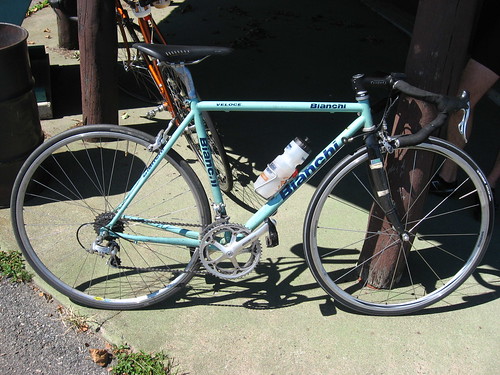
Friday morning, I woke up early to change handlebars on my road bike before I left for work - again. Last week I had put on a different set of handlebars, looking to get a deeper, lower position than my preferred handlebars, Ritchey Biomax bars, afforded me.
I first realized the importance of handlebars and bike fit a little over a year ago, when, after many rides fidgeting and trying to get comfortable on some deep, square-ish ergo drop bars, I picked up those Ritchey bars because of their shallower drop, slight flare, and what I thought would be a more comfortable angle of the ergo section. I realized that the reach was shorter and that given the incredibly wide variety of handlebars, choosing the right handlebar was as much a matter of proper fit on the bicycle as was installing the right length stem. When I discussed bicycle fit with people - especially people for whom bike fit is somewhat tricky, like short people (like myself) - I would always bring up handlebar choice.
This became additionally important when I saw how many entry-level track racers fit themselves on track bikes. I saw a lot of people riding very close and deep; their arms went almost straight down to very deep drop bars. When I bought my Felt, one of the first things I did was give away the ultra-deep Deda drop bars and get Nitto B125s, shallow-drop track bars that are comparable to criterium bars; I recently put on a 120mm stem. My drop isn't extreme and I'm reaching out to the bars a bit more than I'm reaching down to them - it's a stable, long fit that I feel gives me good weight distribution, a good diaphragm-opening reach, and an aero enough posture, without compromising the bike's handling.
Considering my discovery of the importance of handlebar ft, I was pleased to come across this site, which has animations of the different geometries of different drop bars, illustrating the significant differences in reach and drop that different types of handlebars afford. With longer-reach bars having perhaps as much as 3 centimeters more reach than others (which was the case with the bars I just removed from my bike), it's important not to neglect this aspect of bike fit - as much as it's important to not arbitrarily use an 80mm stem rather than a 110mm.
It doesn't necessarily take an experienced and expensive fitter to get yourself comfortable on the bike, although the cost/benefit of that might work out in your favor if you're looking to align optimal comfort with optimal performance, with some other difficult variables thrown in. An amateur can play around by looking at other people's fit, experimenting with saddle position, stem length, and, of course, handlebar dimension.
Showing posts with label road bikes. Show all posts
Showing posts with label road bikes. Show all posts
Friday, May 1, 2009


Derailleur Hanger Mishaps #2
It has been a time of bike repair. Last week I perfected the fine art of bending a derailleur hanger back into alignment. However, just to be on the safe side, I ordered a new derailleur hanger, and though I didn't immediately install it, knowing that my current hanger was probably vulnerable or still somewhat bent, having the spare on hand was reassuring.
A few days ago, while riding over to work for Laek House, the need to install the new hanger became apparent: the old one snapped off and left my derailleur hanging below my chainstay.
I chalk it up to my ongoing ironing out of bad luck in time for yet another big road race, the Bear Mountain Classic. Since some mishaps - a flat tire sustained on deep gravel, a bent hanger sustained in a he-crashed-into-me incident, and a tumble on a descent - have prevented me from contesting the end of Fawn Grove and Battenkill the way I would have liked, I hope that only my strength and fitness, and race acuity will be factors in my placing at Bear Mountain.
Always have a spare derailleur hanger handy. You never know.
A few days ago, while riding over to work for Laek House, the need to install the new hanger became apparent: the old one snapped off and left my derailleur hanging below my chainstay.
I chalk it up to my ongoing ironing out of bad luck in time for yet another big road race, the Bear Mountain Classic. Since some mishaps - a flat tire sustained on deep gravel, a bent hanger sustained in a he-crashed-into-me incident, and a tumble on a descent - have prevented me from contesting the end of Fawn Grove and Battenkill the way I would have liked, I hope that only my strength and fitness, and race acuity will be factors in my placing at Bear Mountain.
Always have a spare derailleur hanger handy. You never know.
Friday, March 13, 2009
Goodbye, Ti. Hello, Co-Mo.
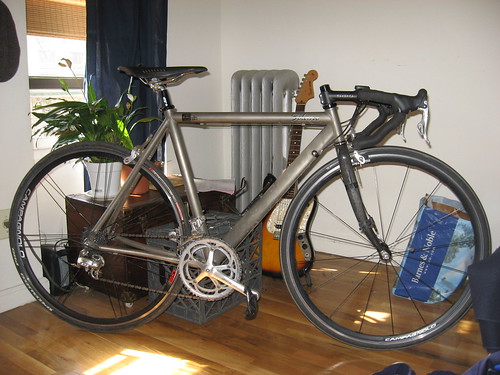 On the left is my now departed titanium Litespeed Solano. It's on its way to a doctor in Wisconsin who plans to ride brevets. I picked it up for a steal in the fall to replace my Tough Little Bianchi - I wanted something a bit snazzier than generic TIGed steel for all-around riding, but something that was also raceable.
The Solano rode well - it was slightly overbuilt for somebody of my size, so was moderately stiff. It rode very predictably, too, which led for really stable descents. Sometimes too stable - I'm a bit more used to snappier handling, due to my experience with track bikes. The titanium is comfortable - a pretty plush ride. All around it was a nice bike - the fat downtube had a nice ridge on top, and the stays were each elegantly curved around the rear wheel. Such immaculate welds, too - so even and fine.
But there were a few things that were off. One was the fit. The reach was near perfect. The height was a bit high on me, and I always felt like I was riding a bike that was too big, even when I was comfortable on it. The bar drop was fine - short people with short arms don't need deep handlebars to get their upper bodies pretty flat, especially if they learn how to bend their elbows and ride somewhat long.
But, I wanted a race-specific bike. Something stiffer and lighter, not an all-arounder.
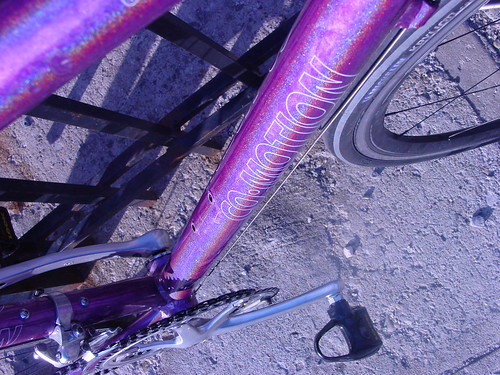
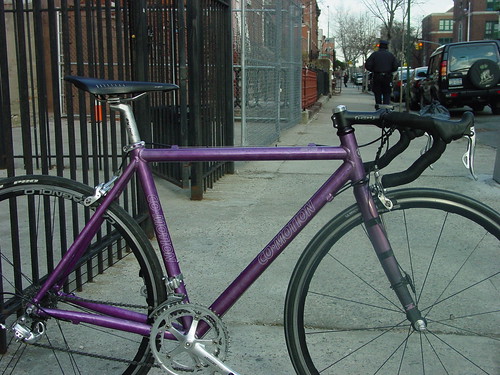 So, when a buddy of mine decided that he needed to liquidate his Co-Motion Ristretto in order to fund the aquisition of a Fuji Track Pro, I jumped on it. I had wanted this bike before, I had ridden it before, and I had seen first hand its purple sheen and its rainbow sparkles.
The day after the decision, I rode to his house, rode home with it over my shoulder, and set about taking the Litespeed apart.
It's lovely. It's a looker. It even looks good at speed (oh, I really wish this photo wasn't blurred!).
Finally, my racing bike is done. A year and a half ago I picked up that temperamental Bianchi. It worked to get me into road riding and racing (I was fixed-gear only for quite a while), but the components were worn. Nine year old Campagnolo bits that refused to shift accurately. Piece by piece, I upgraded: the Litespeed frame, the Campagnolo Eurus wheels and a new rear derailleur at a T-Town swap, and functional shifters for a great price on eBay. The drivetrain was finally working like a drivetrain should, no more light-touching the mouse ear to center the rear derailleur on a cog after shifting (no more wondering if I should attempt the Ergo rebuild on my own).
And now, the Co-Motion frame. It's stiffer than the Litespeed. Big fat straight seatstays transmit that road feel - braile to the arse - but the fork smooths things out. It responds well to hard efforts. I'm liking it.
A lot.
Sunday, March 1, 2009
Relaxing, Bike Handling, and 09's First Race
For a few more road races, I'll be racing in the Cat 5's. I talk a big game, like I know what I'm talking about, but that's mostly because I'm a nerd rather than somebody who's done a lot of racing. Writing this blog is a way to articulate my own learning process.
One of the things I've been learning over and over again this winter is that a relaxed upper body goes a long way toward improving one's cycling. I realized, several weeks ago when I was out on the first long ride in nice weather of the late winter, that my torso and arms were a lot more relaxed while riding. I attribute it to spending time riding on rollers this winter. They force you to relax and let the bike do it's thing. If you try to manhandle it, you'll overcompensate in a snap and ride yourself right off the front roller, into the doorframe, chair, or whatever you are using for support.
Bikes are really great at handling themselves. The way the steering works is really remarkable, taking the fork rake, head tube angle, and lean of the bike into account in a fine equilibrium that really does most of the work for you. I learned, by riding on some terrible urban terrain (loose cobblestones, ruts, and poor asphalt) that the bike can control itself if you take a backseat role. Literally: push your weight back on the saddle, over the rear wheel, and focus on transmitting power to the pedals. Lighten your grip on the bars and let your upper body get loose. The front end will perform its remarkable feat of self-correction.
I put this skill to good use in November's Staten CX race in a section full of off-camber turns, exposed roots, ruts, and rocks. I sat back and powered through, surprising one rider who seemed to gingerly work a line through the mess - as I plowed through he looked up and asked, "How'd you do that?" Poor bike handling in part stems from tension or overcontrol of the bike, and something that I realized in yesterday's Cadence Cup Prospect Park Series (Cat 5 field, remember) is that staying relaxed in a tight pack when there is some oddball behavior around you (riders jamming themselves left to right in their eagerness, and moving unpredictably to capriciously go after a new wheel) - particularly at high speeds - may very well make the difference between staying upright and taking a tumble.
And, though I'm going to largely avoid full-blown race reports, the first race of the season went well. A teammate and I attacked on the second lap, hard, at the top of the "hill." We were away for only about a mile before the pack, still fresh, reeled us in. A lap later, the pace was very high, and then dropped quite suddenly when a lone rider went up the road and nobody was able to respond anymore. I was staying sheltered, twenty wheels back, at that point, still recovering. The rider gained significant time. The pace picked up well on the last half of the last lap, on a fast section of road. There were a few edgy moments at 34mph in a pack tighter than it needed to be, as a lot of people tried to get to the front. But when the terrain stopped providing the speed, the front didn't want to take over and the pace slowed down to maybe 24mph instead of ramping up the speed for a field sprint. So I attacked, hard, with about 800 meters to go. I opened a big gap and went cross-eyed trying to hold my speed and hold off the inevitable field sprint. And I did, mostly. The lead sprinter got me at the line; I threw my bike to prevent the second from doing so, too, and got 3rd place.
Next up: two crits in Connecticut next weekend. I'm taking it easy today, for fun rather than out of a need to recover, and will go for a long hard ride tomorrow.
One of the things I've been learning over and over again this winter is that a relaxed upper body goes a long way toward improving one's cycling. I realized, several weeks ago when I was out on the first long ride in nice weather of the late winter, that my torso and arms were a lot more relaxed while riding. I attribute it to spending time riding on rollers this winter. They force you to relax and let the bike do it's thing. If you try to manhandle it, you'll overcompensate in a snap and ride yourself right off the front roller, into the doorframe, chair, or whatever you are using for support.
Bikes are really great at handling themselves. The way the steering works is really remarkable, taking the fork rake, head tube angle, and lean of the bike into account in a fine equilibrium that really does most of the work for you. I learned, by riding on some terrible urban terrain (loose cobblestones, ruts, and poor asphalt) that the bike can control itself if you take a backseat role. Literally: push your weight back on the saddle, over the rear wheel, and focus on transmitting power to the pedals. Lighten your grip on the bars and let your upper body get loose. The front end will perform its remarkable feat of self-correction.
I put this skill to good use in November's Staten CX race in a section full of off-camber turns, exposed roots, ruts, and rocks. I sat back and powered through, surprising one rider who seemed to gingerly work a line through the mess - as I plowed through he looked up and asked, "How'd you do that?" Poor bike handling in part stems from tension or overcontrol of the bike, and something that I realized in yesterday's Cadence Cup Prospect Park Series (Cat 5 field, remember) is that staying relaxed in a tight pack when there is some oddball behavior around you (riders jamming themselves left to right in their eagerness, and moving unpredictably to capriciously go after a new wheel) - particularly at high speeds - may very well make the difference between staying upright and taking a tumble.
And, though I'm going to largely avoid full-blown race reports, the first race of the season went well. A teammate and I attacked on the second lap, hard, at the top of the "hill." We were away for only about a mile before the pack, still fresh, reeled us in. A lap later, the pace was very high, and then dropped quite suddenly when a lone rider went up the road and nobody was able to respond anymore. I was staying sheltered, twenty wheels back, at that point, still recovering. The rider gained significant time. The pace picked up well on the last half of the last lap, on a fast section of road. There were a few edgy moments at 34mph in a pack tighter than it needed to be, as a lot of people tried to get to the front. But when the terrain stopped providing the speed, the front didn't want to take over and the pace slowed down to maybe 24mph instead of ramping up the speed for a field sprint. So I attacked, hard, with about 800 meters to go. I opened a big gap and went cross-eyed trying to hold my speed and hold off the inevitable field sprint. And I did, mostly. The lead sprinter got me at the line; I threw my bike to prevent the second from doing so, too, and got 3rd place.
Next up: two crits in Connecticut next weekend. I'm taking it easy today, for fun rather than out of a need to recover, and will go for a long hard ride tomorrow.
Wednesday, February 11, 2009
A Personal Best (and, On Losing Part II)
Stephen Roche on La Plagne, Tour de France 1987.
On Monday, three of us met in the morning and headed over the bridge for a training ride. We had no lofty goals for the ride, no intentions of long mileage or tough paces, but we did want to take advantage of the nice day and get some miles in to our legs. And we wanted to ride together, outdoors. Al and I went after some hills together, and on the flats Gui joined us for some traffic light sprints. On the way back from Piermont, Al and I decided to turn off of 9W to take a run at Sherriff's Hill (the Alpine climb), one of the few challenging steep sections within a short ride of New York City. We were a bit exhausted from our ride (despite my intention to work on re-fueling during longer rides, I messed up and felt it), and so looked at each other and decided not to crush it up the hill, just to take it steadily and do it because it's there. We descended the bumpy, twisty cliffside road, called Gui to ask him to time us, and set up the road.
On the bottom third, Al set a steady pace that reminded me that climbing hurts. Two-thirds of the way up I made my way around to embracing the pain, having it drive me with that teeth-gritting damn-the-torpedoes attitude that I'm not entirely familiar with in myself. Gui was there, circling where the road started to level out, and when we drew even he road next to me as I heaved side to side and yelled, "Faster! They're right behind you! You're almost there!" and then, "Six minutes and six seconds," which is faster than I've ever climbed that hill - despite our set-no-records approach to the day. Needless to say it made me feel like I'm making progress and gaining strength for the upcoming season.
I can't climb hills without thinking about Stephen Roche's performance on La Plagne in the 1987 Tour de France. There's a terrific video clip here, where you get to see footage of him collapsing and a later interview ("I just et the road" - priceless). I actually meant to post this as part of On Losing, but forgot, and never went back to edit. Take it as an example of a way to lose with style, pushing yourself so hard that you collapse at the end and your rival doesn't even realize that he's only gained 4 seconds on you at the end of the day. Utterly hard, utterly bad-ass
Roche also gets bonus points for being bashful about his cheeky comment, and translating it to hindsight-language as "I don't think I'll be going dancing tonight."
Friday, October 3, 2008
The Finest Gear That Money Can Buy
 It's been interesting reading reportbacks from Interbike, the cycling industry's annual convention. I wasn't there, as I'm just a lowly enthusiast - in the world, not of it, as the saying goes. But the messageboards and blogs get all fired up with reactions to the new lines of gear, the new aerodynamic improvements of this and that, everybody gushes about the photos of the new technological bit or piece... and then some people buy some stuff, some people forget about stuff, everybody goes about their business. I go back to searching eBay for "Campagnolo 9 speed;" occasionally I might see somebody out in the park, or up on 9W, with a fancy bit of new gear. I saw Campagnolo's 2009 brake/shifter lever bodies a few weeks ago, and they do look and feel lovely. Of course, for a while I've been seeing SRAM Red make the rounds (there's a big display in the window of the bike shop across the street from the building I work in). I wonder how long until I see a Campy-rigged bike with those new shifters and realize that that rear end goes to eleven; or until I see the SRAM-esque hoods of Shimano's electric group, Di-2.
It's an interesting time for the cutting edge. Though the importance of aerodynamics in cycling has been acknowledged by manufacturers since the 80s, aerodynamics seem to be on the rise again - I'm seeing more and more deep-dish carbon fiber rims , even underneath people who seem to be somewhat casual riders. SRAM's entry into the transmission market a few years ago has obviously prompted Shimano and Campagnolo to change the direction of their improvements. Shimano went toward electronics, and Campagnolo, seeking ways to make shifting even faster, wound up with eleven cogs on the rear.
And so, as others have noted, bicycles are getting more expensive. "Cycling is the new golf," say some, noting a rise in boutique, custom bicycles for wealthy amateurs. Meanwhile, bike shops this summer had a hard time keeping anything on their shelves as everyday citizens bought bikes, possibly in response to rising fuel prices.
The surge in the popularity of bicycles, be they for racing or for transportation, is not surprising. It coincides with rising cost of automobile use and a revitalization of American cities, factors which contribute to an argument that bicycles can be used as reliable transportation in many of the country's densest areas. Many of the major companies are making more and more commuter-oriented models, all-purpose bikes, or simple and affordable single-speed/fixed gear bikes. Worldwide, bicycle sales are through the roof, far outpacing the declining automobile sales. Locally and even nationally, cities are in a position to encourage, incentivize, and plan and prepare for transportation choices of the upcoming generations that could dramatically address issues of public health, air pollution, and city traffic congestion. By making dedicated bike facilities - racks, bike lanes, greenways, and traffic enforcement that doesn't just try to keep cars moving as fast as possible - cities can ensure that with increasing the safety of city cycling, they'll increase the number of citizens traveling by bike, therefor decreasing reliance on automobiles.
I can't help but wonder if all the glitz and glamor of the high-end racing market helps or hurts this need for policymakers, urban planners, and the population at large to consider the bicycle as an important part of the transportation network. Is it a sign of misplaced priorities, focusing so much glamor on the wealthiest elements of a sport that so few people understand, anyway? To so many, bikes are just flimsy-looking things ridden by pale, skinny guys on the side of the road wearing tight and ridiculous clothing. On the other hand, generating an economy of wealthy amateurs buying high-priced goods enables these corporations to engage in philanthropic efforts that can indeed support the cause - Trek has supported some significant innovations here in New York City that help raise the visibility and priority of bicycles in the transportation network. Furthermore, these huge companies probably need the credibility that comes with being competitive at the top of the market in order to be able to produce reliable midrange gear, especially considering the technological developments that, in the course of a couple of years, trickle down from the high-end lines to the mid-range equipment.
 There are pressing needs around the world that are being addressed by some significant players in the cycling industry. Craig Calfee has done interesting work developing bamboo bicycles that can be used in rural African areas; Kona's BikeTown project has designed and built bikes that can be used by African health care workers to visit more patients - a unique intersection of transportation and public health, which has been addressed by smaller organizations in the past.
The bicycle is as inherently political as anything else in this world and I urge riders to make the leap from love of the bicycle to an evangelism of sorts. Use what you love to change the world for the better. Support efforts to provide bicycles - a reliable, sustainable, transportation method - to areas and societies that most desperately need them. Support companies engaged in philanthropic work. Support local nonprofit organizations that seek to improve the quality of life in our cities in this area where transportation, public health, and public space policy intersect.
We know how much bikes can change us. Let's find out how much bikes can change the world.
Subscribe to:
Posts (Atom)


 Posts
Posts