Remember during this year's Tour de France, when Armstrong jumped away from the dwindling group of B-climbers and bridged up to that yellow jersey group? All across the internet I saw a few eyebrows go up, questioning Armstrong's move as "chasing down his teammates." This reminded me of a moment at Union Vale, when I launched an attack, bridged up to another rider, and together we worked very hard to bridge up to a two-man break that had been out of sight. One of those to whom we eventually bridged was a teammate. His companion turned to me and said, "Kissena, why'd you chase your own rider down?" I looked behind me. The peloton was out of sight. "That's a bridge, not a chase."
Now, I'm careful not to go overboard with comparisons to pros, because we're not comparable. Our strengths and abilities are so incomparable that the tactics, though similar, are by no means the same. However: bridging is not chasing. Bridging is bringing another motivated rider to a threatening breakaway, and adding motivation to the breakaway.
Bridging is an important tactic that I don't see enough of in Cat 4 racing. I see attacks and I see chases. Attacks, of course, force the pace, hit the field a bit, and test the attacker's ability to gain a lead and hold it. The chase says, "No!" A chase is great if there are primes or points on the line, or if you don't like the composition of the break, or if your sprinter is the shiznitabam. But if you don't have a reason for it, chasing tows people who aren't contributing to the making-things-happen part of the race.
And screw those dudes.
Next time, don't chase. Bridge. Make everybody work. See what can happen. Chances are good that you're not one of the four guys in the field who could win in a sprint. Why not try to bridge up and be in a breakaway that sticks? Can we all agree that the best chances that most of us have of winning are in breakaways, and we should all try to make them happen? That we have to make the race hard, that we have to go hard, and that it's more fun like that anyway?
Please?
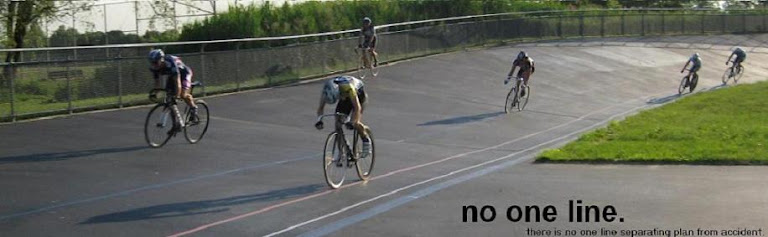
And, for God's sake, if I have just bridged up to you - in a road race, track race, whatever - do not immediately swing off and expect me to "pull through." That is just ridiculous. Give a fellah a second to recover, okay?
Showing posts with label how-to. Show all posts
Showing posts with label how-to. Show all posts
Saturday, August 22, 2009


Monday, April 20, 2009
Derailleur Hanger Mishaps
Friday night, my Co-Motion toppled over as I was about to put it on a repair stand and give the drivetrain a quick clean-and-lube before Battenkill. The fall - minor, slow-motion, usually harmless - bent the derailleur hanger toward the cassette.
Fortunately, one of my teammates is well-accustomed to bending derailleur hangers back into position. By leaving the wheel and derailleur on the bike, you can stick an allen key into the derailleur mounting bolt and use the leverage of the allen key to bend the hanger back into position. When the wheel is left on you can eyeball the alignment of the hanger, looking to see if it is parallel to the smallest cog on your cassette. Before and after doing this, tighten the bolts holding the derailleur hanger on to the dropout.
This probably weakens the hanger a little bit, so when I got back from Battenkill I went to DerailleurHanger.com and placed an order for a #58. You can search by manufacturer and model of bike, but it's not entirely complete, so you can also take a look at a very large batch of replaceable derailleur hangers and see which one matches the one on your bike.
Coincidentally, there was a short message on the team website encouraging riders to always have an extra hanger lying around.
My last experience with hangers was with an integrated (non-replaceable) hanger on my Tough Little Bianchi. While switching derailleurs late last spring, the hanger threads stripped (I use the passive voice because I am hesistant to say that I stripped the threads). I took it to a bike shop that had Helicoil inserts - they drilled out the hanger, inserted the Helicoil, and it was good as new. Helicoils are apparently common repairs in Big Serious Machines (like internal-combustion engines), so there's little doubt indeed that it would hold up to the stresses of a bicycle derailleur.
The rear derailleur, and its hanger, are fragile parts precariously hanging off of your frame. It would be a bummer to consider a race day, a long ride, or even your whole frame ruined because of a mishap, so know how to repair your hanger when it's busted and know what you can do when it's beyond your ability so that you don't prematurely consider your frame to be toast.
Fortunately, one of my teammates is well-accustomed to bending derailleur hangers back into position. By leaving the wheel and derailleur on the bike, you can stick an allen key into the derailleur mounting bolt and use the leverage of the allen key to bend the hanger back into position. When the wheel is left on you can eyeball the alignment of the hanger, looking to see if it is parallel to the smallest cog on your cassette. Before and after doing this, tighten the bolts holding the derailleur hanger on to the dropout.
This probably weakens the hanger a little bit, so when I got back from Battenkill I went to DerailleurHanger.com and placed an order for a #58. You can search by manufacturer and model of bike, but it's not entirely complete, so you can also take a look at a very large batch of replaceable derailleur hangers and see which one matches the one on your bike.
Coincidentally, there was a short message on the team website encouraging riders to always have an extra hanger lying around.
My last experience with hangers was with an integrated (non-replaceable) hanger on my Tough Little Bianchi. While switching derailleurs late last spring, the hanger threads stripped (I use the passive voice because I am hesistant to say that I stripped the threads). I took it to a bike shop that had Helicoil inserts - they drilled out the hanger, inserted the Helicoil, and it was good as new. Helicoils are apparently common repairs in Big Serious Machines (like internal-combustion engines), so there's little doubt indeed that it would hold up to the stresses of a bicycle derailleur.
The rear derailleur, and its hanger, are fragile parts precariously hanging off of your frame. It would be a bummer to consider a race day, a long ride, or even your whole frame ruined because of a mishap, so know how to repair your hanger when it's busted and know what you can do when it's beyond your ability so that you don't prematurely consider your frame to be toast.
Thursday, March 12, 2009
Frame Design: Fork Rake, Head Tube Angle, Trail
 In the part of the cycling world that's perpetuated on the internet - message boards and such - there's a lot of hipster-bashing, centered around ubiquitous photos of very stylish bikes featuring some very nonsensical tradeoffs in build/component choices. A surprising amount of Bike Snob's blog is about these bikes, so I assume you can forgive me for not going into detail. However, for all the talk of hipsters who don't understand how their bicycles work I see road bikers making plenty of silly decisions that seem to stem from an ignorance about the way that bikes work.
One of my pet peeves is misunderstandings about front end geometry: head tube angle and fork rake. Maybe it's because in the fixed gear scene there's a lot of neophyte fretting about "true track geometry" and an infectuous perpetuation of the terms "tight" and "twitchy" without real meaning or understanding behind them. Meanwhile I've heard plenty of road folks who greatly misunderstand the differences between front end design of time trial bikes and road bikes. While I don't claim to be an expert I do think it's important to share good information when it's widely available. And so, some of my favorite resources:
Best introduction I've found is the An Introduction to Bicycle Geometry and Handling, by CHVNK. Dave Moulton's piece is also very well-explained. In particular he narrates the changes made to frame design (with regards to front end design: head tube angle, rake, and trail) in the 50s, from the long-wheelbase bikes of the 1940s and before to the more contemporary-looking bikes with tighter geometry that became the status quo in the 60s. From Urban Velo is a piece by Don Walker: The Truth About Track Geometry, which features a good bit on trail and a bike's handling. And, if you want to run the calculations for your own bike, you can do so with this Excel spreadsheet from Anvil Bikeworks.
The boildown is that head tube angle and fork rake work against each other in order to reach an equilibrium, a sweet spot of trail measurement (60mm, according to Don Walker). Overcompensating one because of a lack of the other is counterproductive: putting a road fork on a track bike with a steep headtube angle will make the handling less stable - the higher-rake fork reduces the trail measurement. A "road" fork doesn't make a bike's handling more stable - it will make it less self-correcting. Putting a low-rake fork in order to tighten up the front end of a bike with a slack head tube, rather than bringing a bike's handling closer to neutral, will push it toward very-high-rake, sluggish handling. Which is fine, if you want a road bike that handles like a cruiser. I learned this first hand, picking up a carbon fork for my every-day bike with a 72deg headtube. The fork turned out to have 28mm of rake: too low to neutralize the handling - it was sluggish.
Don't make the mistake of making uninformed decisions about this stuff. You don't have to know everything about how your bike works in order to ride it, but if you're going to change things and make product decisions, be discerning about what information you file away as reliable in your head. Not everybody posting on Bikeforums, nor every shop employee, gets everything right all the time.
For me, soaking up information about this stuff is part of what makes cycling beautiful. When I lean my bike into a corner, I know that there's a very elegant design that's practically making the bike handle itself. Furthermore, knowing how and why your bike works the way it does just might make you a better rider when the going gets rough...
 (closing image courtesy of Cycling Art Blog)
Subscribe to:
Posts (Atom)


 Posts
Posts


