Recently I spent a little while during a long, lazy autumn morning trying to plan when I would pull on my kit and go for a low-intensity, get-the-legs-moving ride in Prospect Park. In the bathroom, brushing the coffee out of my teeth, I looked down at my legs and realized that as much as underemployment might give me plenty of time to ride, I'm not making the most of it. My legs are unshaven. My excuse or reason is that there is no need to keep up appearances when race season is over. The reality that struck me, however, was that I haven't done a whole lot of riding in recent weeks.
I did squeeze in a really wonderful Century a few weeks ago, out to Montauk. Al and I put our heads into the wind and ground along for five hours, then stopped for a bunch of pizza, to watch the cold wind and the waves on the abandoned dunes, then climbed on the LIRR for a lazy train ride back. Six days later I did sixty or seventy miles through the city, up toward Nyack, and then down into New Jersey for family reasons, and the fatigue in my legs suggested that I had been lazy with my recovery - I hadn't ridden between those two long rides, and my recovery is best when I'm riding almost constantly. When I'm not tiring myself but always keeping my legs going.
In order to better be able to evaluate myself and keep myself on a schedule, I put together an excel spreadsheet that will let me track my riding and make plans and changes where I need to. One of the downsides of no longer living up in the Bronx means that everything I do no longer has a twenty to thirty mile round trip associated with it. This eats into my base miles.
However, this week I'm starting part-time work on my bicycle, which will get me on the bike every day and putting in some miles. That, combined with my excel spreadsheet, should keep me moving, thoughtful, and motivated.
It's been rainy a lot in the past couple of weeks. As November starts to get dark and grey it will be harder to really want to ride, and despite the fact that I welcomed autumn with open arms this year, it won't be long before I long for those warm spring days when you take the first opportunity to dress lightly and go out for long rides under the new sun. I plan to be well-prepared for next season's racing, though, and that will require me gritting my teeth and getting the miles in throughout the winter.
We'll see how I do.
Saturday, November 15, 2008


Monday, November 3, 2008
Wine, cheese, and bearing grease.
Cycling is on the rise. To hear about greying locals talk about the sport twenty, thirty, or forty years ago, it was a blue-collar sport. Al Toefield was a cop who managed Olympic Teams, got the Kissena Velodrome built, and founded the Kissena Cycle Club; David Walker was a cop too, working in community relations, who started one of New York City's biggest and most enduring races, the Harlem Skyscraper Classic Criterium. Pete Senia, it seems, organized most of the races in the 70s and 80s that laid the foundation for the cycling scene. I hear stories of these men driving vans full of young, aspiring racers - just kids - to the races in the pre-dawn hours of the morning. The scene consisted of a lot of dedicated, working-class men, a lot of immigrants. Circling Prospect Park on a Saturday afternoon, there are still groups of older Caribean men, and mustachioed Latino men, riding bikes from the 70s and 80s - Nuovo Record, downtube shifters - wearing faded colors, muted kits from bygone days.
The working-class flair that local bicycle racing had matches the technology from the time - when you're talking about a lugged steel bike with 32-spoked wheels and downtube shifters, there's really not a huge technological gap between entry level and high-end (leaving out, of course, the 1970s era Bike Boom's drive to create cheaper and cheaper frames and components). Sure, there were ways to ramp up the cost of a bike - get the frame custom made, rely on Cinelli and Campagnolo parts - but at the end of the day, the manufacturing process and the final product between basic and bling were going to look a lot alike.
These days, the price-to-quality graph looks a lot more exponential - the higher you climb, the faster the prices increase, and the less you get for these increases. Campagnolo's new Super Record 11 groupset - cranks, cogs, front and rear derailleurs, brake/shifter levers, and brakes - cost upwards of $2,000, while last year's midlevel groupset, Veloce, sells for around $600. One can get a great frameset for well under a thousand dollars - indeed, just several hundred if you're looking for somethins used - but high-end, specialty carbon fiber framesets can readily run to several thousand dollars, even climbing over the $10,000 mark. The higher up on the scale you go, you pay more and more for smaller and smaller improvements in performance, quality, or manufacturing - a rapidly declining value system.
Ironically, the growing popularity of cycling is turning it into a more exclusive sport. Case in point - I was recently at an event featuring one of the world's greatest cyclists. As the event's attendants inconspicuously crowded around and waited for a pin-sized gap in the conversation so that they could speak to (to, not with) a consistent high finisher in the Paris-Roubaix, the conversation somehow turned to high finance, and almost everybody in this circle - barring myself, a journalist, and Big George Hincapie - chimed in. Not just everybody bearing an opinion about the collapse and the bailout - instead, it seemed that everybody present was in the industry. "Oh, so you must know so-and-so at Big Firm, then." These are the consumers in the new cycling industry, an industry of "it goes to eleven," of this year's model, of custom carbon fiber, of powermeters and high-end aero wheels for the casual racer.
Threads on the internet asking when you know your frame is obsolete. Though people know that while the industry churns out "improvements" each year, the bike that you bought two, four, or ten years ago is still just going to rely on the juice that's in your legs - and yet, the industry plows on and people buy the bikes with the newest graphics. Friends, it's an economy of wine, cheese, and bearing grease, but unlike wine and cheese, I fully plan to turn this to our advantage by looking at the resale markets of so-called "obsolete" components.
The working-class flair that local bicycle racing had matches the technology from the time - when you're talking about a lugged steel bike with 32-spoked wheels and downtube shifters, there's really not a huge technological gap between entry level and high-end (leaving out, of course, the 1970s era Bike Boom's drive to create cheaper and cheaper frames and components). Sure, there were ways to ramp up the cost of a bike - get the frame custom made, rely on Cinelli and Campagnolo parts - but at the end of the day, the manufacturing process and the final product between basic and bling were going to look a lot alike.
These days, the price-to-quality graph looks a lot more exponential - the higher you climb, the faster the prices increase, and the less you get for these increases. Campagnolo's new Super Record 11 groupset - cranks, cogs, front and rear derailleurs, brake/shifter levers, and brakes - cost upwards of $2,000, while last year's midlevel groupset, Veloce, sells for around $600. One can get a great frameset for well under a thousand dollars - indeed, just several hundred if you're looking for somethins used - but high-end, specialty carbon fiber framesets can readily run to several thousand dollars, even climbing over the $10,000 mark. The higher up on the scale you go, you pay more and more for smaller and smaller improvements in performance, quality, or manufacturing - a rapidly declining value system.
Ironically, the growing popularity of cycling is turning it into a more exclusive sport. Case in point - I was recently at an event featuring one of the world's greatest cyclists. As the event's attendants inconspicuously crowded around and waited for a pin-sized gap in the conversation so that they could speak to (to, not with) a consistent high finisher in the Paris-Roubaix, the conversation somehow turned to high finance, and almost everybody in this circle - barring myself, a journalist, and Big George Hincapie - chimed in. Not just everybody bearing an opinion about the collapse and the bailout - instead, it seemed that everybody present was in the industry. "Oh, so you must know so-and-so at Big Firm, then." These are the consumers in the new cycling industry, an industry of "it goes to eleven," of this year's model, of custom carbon fiber, of powermeters and high-end aero wheels for the casual racer.
Threads on the internet asking when you know your frame is obsolete. Though people know that while the industry churns out "improvements" each year, the bike that you bought two, four, or ten years ago is still just going to rely on the juice that's in your legs - and yet, the industry plows on and people buy the bikes with the newest graphics. Friends, it's an economy of wine, cheese, and bearing grease, but unlike wine and cheese, I fully plan to turn this to our advantage by looking at the resale markets of so-called "obsolete" components.
Thursday, October 9, 2008
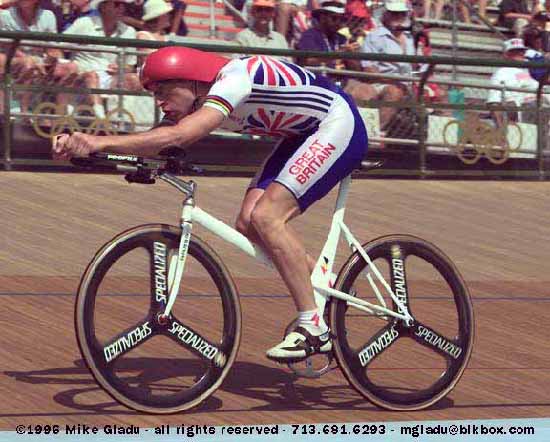
Ken Harris, holder of World Hour Record (40-45) and the Kissena Velodrome Hour Record
 Over at Velocity Nation, there's a nice interview with Ken Harris; there's another one on CRCA's website. Ken recently set the World Hour Record for his Master's age category, (40-45). He shares some interesting tidbits about his training, his aerodynamics, and his gearing, so it's an interview that satisfies the nerd in each fan.
Harris set the record by riding 45.6 km (28.3 miles) in one hour on September 23rd, 2008, at the Trexlertown Velodrome, a few weeks after setting the Kissena Hour Record here in New York City by riding 44.17 km, or 27.45 miles. Those of us who are Kissena regulars know Ken as the tall guy in the Adler kit who punishes the 1/2/3 field on a regular basis. The '08 Twilight Series Results will testify to this.
The Hour Record is a holy grail of sorts in the cycling world. Eddy Merckx considered his 49.431 Hour Record the hardest ride he'd ever done; attempts to challenge his record led to riders and their coaches designing increasingly bizarre bicycles in attempts to gain aerodynamic advantages. Merckx, on the other hand, rode what was state-of-the-art for his 1972 record effort - a lugged-steel track bike with drop bars and traditionally spoked wheels. The developments being made in cycling technology led the UCI to seperate the Hour Record and the Best Human Effort, in order to distinguish between athletes riding "traditional bicycles" like Merckx's, and those riding some of the more unique creations that the sport has seen.
And so, notables like Francesco Moser, Graeme O'bree, Michael Indurain, and Chris Boardman assaulted Merckx's legacy with disc wheels, unique positioning, and curiously-shaped carbon fiber frames, but the UCI retroactively bumped their otherwise record-breaking attempts into the Best Human Effort category. Think of it as being similar to Major League Baseball's requirement that all players use wooden bats - a somewhat arbitrary line that requires traditional tools in an attempt to keep the playing field even, hoping to ensure that the event remains about the athlete, not the equipment (this bears a certain similarity to Japanese Keirin racing). Meanwhile, Merckx's record stood until 2000, when Chris Boardman managed to ride only about 30 feet further than Merckx had. The current record holder, Ondrej Sosenka, improved on Boardman's effort by 260 meters, or .16 mile. The fact that so little progress has been made in this area, though athletic records in so many sports regularly get shattered is a testament not only to Merckx's dominance of the sport but of the unique challenges, both mental and physical, of the Hour Record: get on the bike, affix your shoes to the pedals, grab the bars, put your head down, and go. For an hour. At about thirty miles an hour.
It's the stuff of legends, and of good stories, pretty thoroughly intertwined in the history of racing and technology in recent decades. Thanks to the efforts of, and rivalry between Graeme O'Bree and Chris Boardman in the 1990s, the field of cycling aerodynamics grew rapidly.
It's nice to know that somebody in our little corner of the cycling world, dominated by the same old park circuits and bumpy velodrome, holds a corner of a record that is imbued with such history, held by such cycling greats.
Good job, Ken.
Friday, October 3, 2008
The Finest Gear That Money Can Buy
 It's been interesting reading reportbacks from Interbike, the cycling industry's annual convention. I wasn't there, as I'm just a lowly enthusiast - in the world, not of it, as the saying goes. But the messageboards and blogs get all fired up with reactions to the new lines of gear, the new aerodynamic improvements of this and that, everybody gushes about the photos of the new technological bit or piece... and then some people buy some stuff, some people forget about stuff, everybody goes about their business. I go back to searching eBay for "Campagnolo 9 speed;" occasionally I might see somebody out in the park, or up on 9W, with a fancy bit of new gear. I saw Campagnolo's 2009 brake/shifter lever bodies a few weeks ago, and they do look and feel lovely. Of course, for a while I've been seeing SRAM Red make the rounds (there's a big display in the window of the bike shop across the street from the building I work in). I wonder how long until I see a Campy-rigged bike with those new shifters and realize that that rear end goes to eleven; or until I see the SRAM-esque hoods of Shimano's electric group, Di-2.
It's an interesting time for the cutting edge. Though the importance of aerodynamics in cycling has been acknowledged by manufacturers since the 80s, aerodynamics seem to be on the rise again - I'm seeing more and more deep-dish carbon fiber rims , even underneath people who seem to be somewhat casual riders. SRAM's entry into the transmission market a few years ago has obviously prompted Shimano and Campagnolo to change the direction of their improvements. Shimano went toward electronics, and Campagnolo, seeking ways to make shifting even faster, wound up with eleven cogs on the rear.
And so, as others have noted, bicycles are getting more expensive. "Cycling is the new golf," say some, noting a rise in boutique, custom bicycles for wealthy amateurs. Meanwhile, bike shops this summer had a hard time keeping anything on their shelves as everyday citizens bought bikes, possibly in response to rising fuel prices.
The surge in the popularity of bicycles, be they for racing or for transportation, is not surprising. It coincides with rising cost of automobile use and a revitalization of American cities, factors which contribute to an argument that bicycles can be used as reliable transportation in many of the country's densest areas. Many of the major companies are making more and more commuter-oriented models, all-purpose bikes, or simple and affordable single-speed/fixed gear bikes. Worldwide, bicycle sales are through the roof, far outpacing the declining automobile sales. Locally and even nationally, cities are in a position to encourage, incentivize, and plan and prepare for transportation choices of the upcoming generations that could dramatically address issues of public health, air pollution, and city traffic congestion. By making dedicated bike facilities - racks, bike lanes, greenways, and traffic enforcement that doesn't just try to keep cars moving as fast as possible - cities can ensure that with increasing the safety of city cycling, they'll increase the number of citizens traveling by bike, therefor decreasing reliance on automobiles.
I can't help but wonder if all the glitz and glamor of the high-end racing market helps or hurts this need for policymakers, urban planners, and the population at large to consider the bicycle as an important part of the transportation network. Is it a sign of misplaced priorities, focusing so much glamor on the wealthiest elements of a sport that so few people understand, anyway? To so many, bikes are just flimsy-looking things ridden by pale, skinny guys on the side of the road wearing tight and ridiculous clothing. On the other hand, generating an economy of wealthy amateurs buying high-priced goods enables these corporations to engage in philanthropic efforts that can indeed support the cause - Trek has supported some significant innovations here in New York City that help raise the visibility and priority of bicycles in the transportation network. Furthermore, these huge companies probably need the credibility that comes with being competitive at the top of the market in order to be able to produce reliable midrange gear, especially considering the technological developments that, in the course of a couple of years, trickle down from the high-end lines to the mid-range equipment.
 There are pressing needs around the world that are being addressed by some significant players in the cycling industry. Craig Calfee has done interesting work developing bamboo bicycles that can be used in rural African areas; Kona's BikeTown project has designed and built bikes that can be used by African health care workers to visit more patients - a unique intersection of transportation and public health, which has been addressed by smaller organizations in the past.
The bicycle is as inherently political as anything else in this world and I urge riders to make the leap from love of the bicycle to an evangelism of sorts. Use what you love to change the world for the better. Support efforts to provide bicycles - a reliable, sustainable, transportation method - to areas and societies that most desperately need them. Support companies engaged in philanthropic work. Support local nonprofit organizations that seek to improve the quality of life in our cities in this area where transportation, public health, and public space policy intersect.
We know how much bikes can change us. Let's find out how much bikes can change the world.
Thursday, October 2, 2008
Racing and Renaissance - the Kissena Velodrome
 The Kissena Velodrome was built in 1962, a project of the infamous Robert Moses - he also gave us some pretty terrific public pools, some pretty terrible public housing, some pretty terrific public parks, and highways that block generations of New Yorkers from accessing New York City's significant and beautiful waterfront. Thanks, Mr. Moses.
Kissena was built out in Flushing, Queens. In order to unite cyclists from around the tri-state region, it's close to the Long Island Expressway and the Whitestone and Throg's Neck Bridges, making it pretty accessible by car from New Jersey, Connecticut, and Long Island; of course, it's also only a half-hour bike ride from Midtown Manhattan or North Brooklyn, where many of today's Kissena riders live.
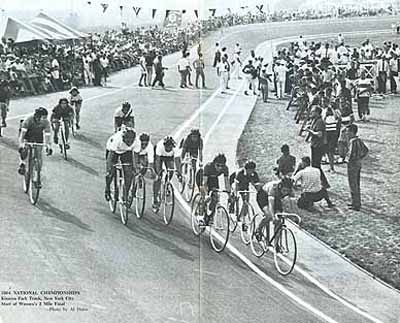
The 1964 Olympic Trials were held at the Kissena Velodrome, and for a while, it occupied a very special place in this country's track racing world - five of eight riders on the '64 Olympic team were from the Kissena Velodrome. Over the years, though, it fell into disrepair, until in 2002 Bicycle Magazine called it the worst track in the country. Unfenced, bumpy and ridden with weeds and cracks, it was occasionally refered to as the Paris-Roubaix of velodromes (after a famous grueling French cycling race that partially takes place along thin, muddy, wretched cobblestone roads).
In 2004, however, much-needed renovations were completed and a renaissance of sorts began. Figureheads in the messenger community organized and promoted races to messengers; track director John Campo recruited racers, youths, and other athletes with his trademark big grin and contagiously friendly nature. Attendance grew; in the 2008 season, anticipated ridership was so great that track officials decided to split the weeknight Twilight Series into two nights - Juniors, Women, and Masters on Monday nights and open fields (Categories 1/2/3, 4, and 5) on Wednesday nights. Highlights include 60 people for Super Sprint Sunday, and 99 people for the State Championships.
The renovations and rider renaissance have not made a perfect velodrome, however. There are still bumps in the surface low in turns 2 and 4 that can leave you a bit wide-eyed as you pull your rear wheel back underneath you and back off of your sprint; other park users occasionally hop the fence, unaware that there is a bike race being conducted at over 30mph; the only facility is a port-a-potty and there's precious little shade. During weekend track meets in the summer, everybody fights for shade, huddling under rickety canopies erected in the infield. Wind gusts from the west can blow you almost to a standstill when you're coming around turn 2 and heading on to the back stretch.
My July trip to the Trexlertown Velodrome in Pennsylvania showed me how beautiful an outdoor velodrome could be - big bleachers, bathrooms and changing rooms with lockers and showers; an overhead pass so nobody has to scramble across the track. Smooth, steep banking so that you can tear around the track at higher and higher speeds; lights so that the races never have to end earlier and earlier as the summer's evenings grow shorter.
But Kissena's imperfections inspire love and devotion, and camaraderie amongst racers. It's low-key, down-home environment doesn't take away from the competition. Rather, it welcomes burgeoning racers, inspires them to work their way up the ranks of the amateur categories, and sends them off into the wider world of cycling. Kissena's racers have won National Championships. Among those who cut their teeth at Kissena is Nelson Vails, a NYC messenger turned world-class racer. More recently, one of Kissena's current top riders, Ken Harris, set the World Hour Record for age group 40-44, riding 28.5 miles in one hour.
Kissena is a track where there's frequently barbecuing during events, where riders greet each others with high-fives while they unsling messenger bags containing their work clothes and water for the evening's races. The older men from Long Island roll out their track bikes from their cars while the younger racers, riders in their twenties who've ridden here on a Wednesday evening from day jobs in Manhattan, Brooklyn, Queens, and the Bronx pull 15mm wrenches, lockring wrenches, and chainwhips out of their bags to transition from their street-riding gearing to their track-racing gearing. Alan Atwood, the friendly and boisterous official, greets almost everybody by name, and to run the races he needs nothing more complicated or expensive than a whistle, a pencil and clipboard, and his sturdy lungs. "Two thirty-three, you're out!" he booms across the track during a Miss-and-Out, where the last rider across the line each lap is pulled from the race. "Two thirty-three!" On Thursday, pictures of the races will be posted on Kissena Track Racing blog, maintained by Mike Mahesh. Occasionally, he also posts pictures from Kissena in the 1980s - when Mahesh himself started racing there.
The Kissena Cycling Club takes its name from the tri-state area's only velodrome. As I look toward a busy 2009 racing season, I'll be excited to don the Kissena kit as a member of the club.
On her blog with Bicycling Magazine, Olympic hopeful Liz Reap-Carlson wrote fondly of her trip to Kissena, relaying the view of a friend of hers that "it would be great if someone took the money it takes to build one ADT Center and made 10 Kissenas here in the US."
I couldn't agree more. Three cheers for down-home velodromes.
Subscribe to:
Posts (Atom)


 Posts
Posts