Tuesday, December 30, 2008

Why Track?

There's a thread over in the Road Racing forum at bikeforums asking what Category 5 criteriums are like. It's largely some banter about Cat 5 racing. In cycling, listening to people talk about Cat 5 racing is kind of like listening to high school sophomores talk about freshman. There are a couple of convenient put-downs and it makes people feel like they're a bit more advanced. I mean, come on - calling Cat 5 the "Crash 5" isn't even a good play on words!

I read this thread and I sat back, wondering why I felt a little bit defensive. I'm currently a Cat 5 - I spent my first racing season focusing on track racing, with a handful of road races thrown in here and there, mostly for fun. Now I've got some racing experience under my belt and I'm gearing up for a full season of road racing, but still a Cat 5. I guess that I'm proof of something - hey, I know what I'm doing when I'm racing! Not all Cat 5's have no idea how to attack a field or sprint or...

Where'd I learn that racing stuff?

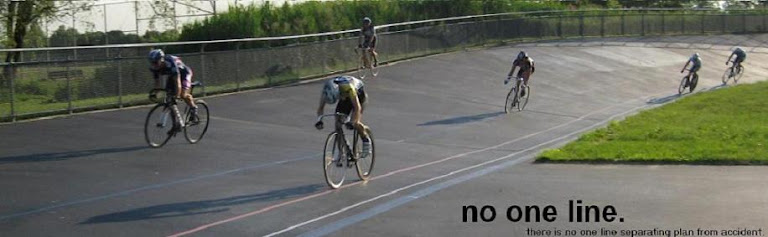
Hint: it's a bumpy banked oval out in Queens (side note: I recently learned that "Kissena" means "It Is Cold" in Algonquin - which fits all too well VeloCity '08, mentioned in this post (video at the end)).

Which brings me to my advice: want to learn how to race? Race at the track. The logic is simple. You can hop in a road race and spend some time groveling at the tail end of things and not even see how races develop. Or you can straddle your bike at the velodrome during an omnium, hop on to the banking, race in a smaller pack where the race happens faster, right in front of you, over and over. And when you get off, spent and exhausted, coughing and grabbing for your waterbottles, you can watch the other fields - specifically, the more experienced riders - do the same races.

And you can learn: oh, that person made a move stick on a faster field because of how he came off the banking on turn 4 (lesson: attacks have to be fast). If he would have done it on turn 2 he would have been going into the wind (lesson: be aware of the environment and terrain). And those riders two work together (lesson: make secret teammates). And that guy's a sprinter who can turn it up on the last 200m, so in this race format they're wearing him down, fast (lesson: just because somebody's faster than you, doesn't mean you can't beat them).

I'm entering the road season feeling like I know what I'm doing. I'm planning to be consistent at some early-season criteriums with a friend or two (Plainville and Bethel), and I'm already developing a couple of different plans on what to try when in different races.

Of course, plans will only take you so far. Time to get out the rollers.

And a parting word of advice - if there's a velodrome within a few hours of where you live, borrow a track bike or buy a cheap one, and go hit the banking.

Saturday, December 27, 2008

Hey, why not? It worked in Blazing Saddles.

My secret source of shame is that I'm a fairly poor bike mechanic. I cut my teeth at a bike co-op that I cofounded, which means that I was tinkering with junkers. It was the "hammer-and-duct-tape" school of bike repair.

Then I started riding fixed gear bikes. Fixed gear bikes are a small step above the hammer-and-duct-tape school of bike repair. It's very easy to wrench on fixed gears, and very hard to mess anything up. No finesse is required. No special tools are required. In fact, if you don't have a chainwhip for changing cogs, you can make do with your frame and the chain that's already on it.

I'm tenacious, though, so have thrown myself headfirst into a few challenging tasks. I've built a handful of wheels, and I also built up my roadbike from a bucket's worth of parts. I measured each length of cable and housing a dozen times before cutting it (I still need to re-trim since I changed stems and handlebars). I fiddled with the alignment and tension of each derailleur about a hundred times in the first week or two. Practice makes perfect, and I got a lot of chance to practice on this one bike. Not quite at perfection yet, but I'll attribute that to Ergo levers that need to new G-springs.

Casting shame on my clumsy hands is a mechanic in a bike shop in Bloomfield, New Jersey who is blind. Apparently the tasks that I muddle through can indeed be mastered through persistence and experience, but also can be done without sight.

I'd love to be a fly on the wall in that shop, seeing what tasks Mr. Tinsley does and doesn't do, and how. Does he measure lengths of chain? Does he feel the alignment of a stem to the front wheel?

I just read an interview with Roger Aspholm, a dominant local racer. He talks about experienced riders training by feel rather than by science: knowing what your body is capable of, how to push your limits, how your body responds to duress. It's neat to think that the love for the bike could lead to similar feel for tools and bikes, not just one's body.

Several years back, as a grimey mechanic was putting cranks onto my bike while I hung around asking questions about everything that I could, I asked him how he knew when the square-tapered cranks were on snug enough. He had just leaned into the wrench, bringing it and the crank together, smoothly and forcefully installing the crank onto the spindle. He shrugged and mumbled, "Been doing it for fifteen years."

Wednesday, December 24, 2008

Accidental Tendencies Toward Underdog Stories

I have an excel spreadsheet - my training outline. It's got all the dates for the next several months on it, and for the past six weeks or so I've been recording what riding and other exercises I've done. It helps me look back on the last week, and on to the next week, and think, Okay, did so many miles. I should plan for another longer ride on Thursday; and I should make sure to do leg workouts on these three days. And ride rollers for an hour tomorrow morning.

I'm really just starting my commitment to training - my season of racing in '08 was largely based on my fitness and strength as a commuter. One of the things that's regularly on my excel spreadsheet is an entry - "15C." Many days- 15 miles, commuting pace. It's a conservative estimate of the ride in to my delivery job, a few nonsense miles during my shift, and the ride back. A busy day is probably more like 20 miles - nothing to brag about. Getting the blood flowing in my legs. Spinning quickly up 10th Avenue, back down 9th. Bikerattling romps over cobblestones in the meat packing district. And, in weather like last week, slipping and sliding around a fair amount.

It's not much of training. It's not endurance, I don't do intervals, and though I do put effort into my accelerations it's not like I'm launching Monster Sprints in my low-geared fixed workbike. So what good is it? Well, it keeps me on the bike. It keeps my legs supple. It lets me feel my progress, my fatigue and my strength, as I work out indoors.

I think that it also fertilizes a useful stubbornness - a willingness to ride as far as it takes for as long as it takes, in as much discomfort as it takes. The cranky commuter mentality just might be a lot closer to the classic definition of the cycling "hard man" than your average road racer. Those of us who are out on the streets day in and day out, whether commuting or working on our bikes, have a different relationship with the bike. It's not a toy, not a hobby, not a beloved exercise machine. An integral part of every day life - no choice, but simple fact. It's a prosthesis, and with it we are coordinated, adept, as smooth as if it were a part of us. Last week, I stubbornly pulled on a pair of pants over my tights and two pairs of socks as I set out in temperatures touching down at 15F. I snarled at the weather and launched myself head first in to it. I had to get to work. It's not like in New York City we've got a whole lot of room indoors in which to train, anyway. I set up my rollers in the kitchen doorway, with just enough clearance from the refrigerator (behind me) and the couch (in front of me).

I never trained for my first season racing - I just commuted every day, about 24 miles round trip from the Bronx, through the cold months, the rain and the snow, the traffic, the darkness, and into the spring and summer, into the insistent heat and humidity, the perpetual sweat. Fatigued? Saddle up - you've got another forty minutes of riding before you get home.

Maybe it will make me stronger, more bullheaded. Maybe just provide that chip on the shoulder, that motivation to work hard, to train with my body, to race hard on used bicycles, to prove to myself and anybody who might listen that a scrappy punk-rock underdog with a slim budget can race with the big boys. It's a story I play out largely in my head, the old trope about the outsider.

Maybe it's a little bit silly since I've never been made to feel like an outsider while racing.

But there it is.

Wednesday, December 17, 2008

There's Always More To Learn

My brain has a tendency to store somewhat useless data. As a child I would sit down and read the Encyclopedia when bored; memorize Hardy Boys novels; accidentally imprint long monologues from Brian Jacques novels into my brain (usually sections dealing with feasts and food). It makes being a bike dork fun, because somehow, a bunch of information that I find interesting just gets stored away, and when I lest expect it, my homunculus will rummage through those cerebral filing cabinets and pull out some esoteric factoid (much to the delight, no doubt, of my conversational companions).

So, when it comes to bikes, I really like seeing new things that I just plain-old haven't been exposed to yet. Last week it was Cantiflex Tubing, used by Bates in the 1930s as a way to make oversized tubing work with conventional lugs. It's a curious little corner of frame construction.

Even more so comes from this Casati pursuit frame currently on eBay, with the photo above. The 1980s and 1990s saw revelations about the importance of aerodynamics in cycling (see, for example, 1989's Lemond v. Fignon, and some more details here) - time trial bikes got lower front ends, Greg Lemond introduced aero bars to much controversy, and disc wheels - brought to the sport by Moser's hour attempt gained more widespread use. I always enjoyed this video of a 1987 Tour de France team time trial - you can see different aerodynamic developments being employed by different teams.

But I've never seen a bike with such design as that Casati. It seems to me to be a flawed frame design, , sacrificing front end stiffness (admittedly not of paramount importance in a pursuit) for - well, I'm not exactly sure what for.

Conversations about experimental frame design almost inevitably turn toward somebody saying, "There's a reason that the double-triangle frame design has been used regularly for a hundred and fifty years." It's true - it's a good design. But there's something about all the experiments, the attempts to create something new and revolutionary, that makes the standard classic racing bicycle even more beautiful. I suppose that's part of why I love the stories behind the Hour Record - it's got experimentation, that unusual combination of engineering and athleticism, and the story ultimately forks, reigning in one element in order to let the other blossom.

Thursday, December 11, 2008

Recycled Content #1

When I started No One Line a few months ago, I made a point not just to repost photos found on other blogs. No offense meant to bike bloggers who do, but I take inspiration from blogs like Belgium Knee Warmers and Sprinter Della Casa - I want this to be writing about cycling, not just snapshots.


However, this post is going to focus on recycled content. In the last few days I've been sitting around, thinking about my winter training, poking around on bike blogs, watching race videos while riding rollers, and just generally immersing myself in the excitement of waiting for the 09 season to start. Here are a few of what I've been spending my daydreaming with:

Hipster Nascar has some photos of a new indoor velodrome being build in Boulder, Colorado (website; image above). Track dimensions: 143 meters, 45 degree banking. I'm used to riding on the Kissena Velodrome - 400 meters, 17 degree banking. The thought of an extremely short, extremely steep 'drome... it's a bit of a sphincter-clencher.

I usually forget to check VeloGoGo with any kind of frequency (and I don't use an RSS feed anymore), but when I do, I'm rewarded with lush imagery and insane componentry (if you want to spend $1200 on your brakeset...).

Meanwhile, when Belgium Knee Warmers takes a break from writing about embrocation, they offer some stunning race clips. Their short commentary says it all: Attacking on a descent in the rain and drifting both wheels on your way to catching '86 World Champion Moreno Argentin and beating him in the sprint is stunningly PRO.

And, bringing it all back home, Kissena Track Racing has photos from last month's 150 lap end-of-season ride at the Velodrome. As much as I love Kissena I'd be hard pressed to keep my brain stimulated during such a period of around-and-around. I love the cold, windswept look of the velodrome in the autumn. It reminds me of Cyclehawk's VeloCity 2008 tournament from this past March - the dead and browned infield grass, the 31-degree temperatures, the painfully clear blue cold sky. Video is here: